
Key Takeaways
"Recovery systems fail for a simple reason. They ask people to store waste, remember it, and carry it somewhere else later. Every extra step loses people."
"Mill, Suri, and LensLoop are unrelated companies solving unrelated waste problems. They all built recovery into the exact moment the waste is created, without ever comparing notes. So did PlanetCare, the laundry filter company we've written about before."
"LensLoop reached a 93% per-user capture rate in an 18-month beta. Suri reports a 35% customer return rate on used toothbrush heads. Mill shrinks kitchen scraps by 80% overnight, right on the counter."
"None of these systems ask the user to change their routine. The recovery point simply sits where the old habit already happened."
Every Recovery System Fails the Same Way
Almost every recovery program that fails, fails for the same reason. It asks someone to do something later, in a different room, with an item they have to remember to keep. Store the batteries in a drawer until the drawer is full. Save the aluminum foil and blister packs in a bag under the sink, since curbside programs won't take them, and hope to remember the bag next time you happen to be at a store that does.
Most people who skip these steps aren't careless. Normal life doesn't leave room for a second errand attached to garbage. We wrote about this in detail when we looked at why contact lens recycling programs keep failing. The short version: the programs work fine on paper and fall apart the moment they meet a real bathroom, a real morning, and a person who's already running late. A survey of 1,243 wearers across 16 countries backed this up. Most said they wanted to do the right thing. Almost none of them were.
Read: Contact Lens Waste: Why Recycling Programs Keep Failing
The Pattern Keeps Showing Up
We already told the laundry room part of this story, when we wrote about how PlanetCare fits a microfiber filter into a routine nobody has to think about. What's interesting is watching that same fix show up in two more places, built by people who were never in the same room.
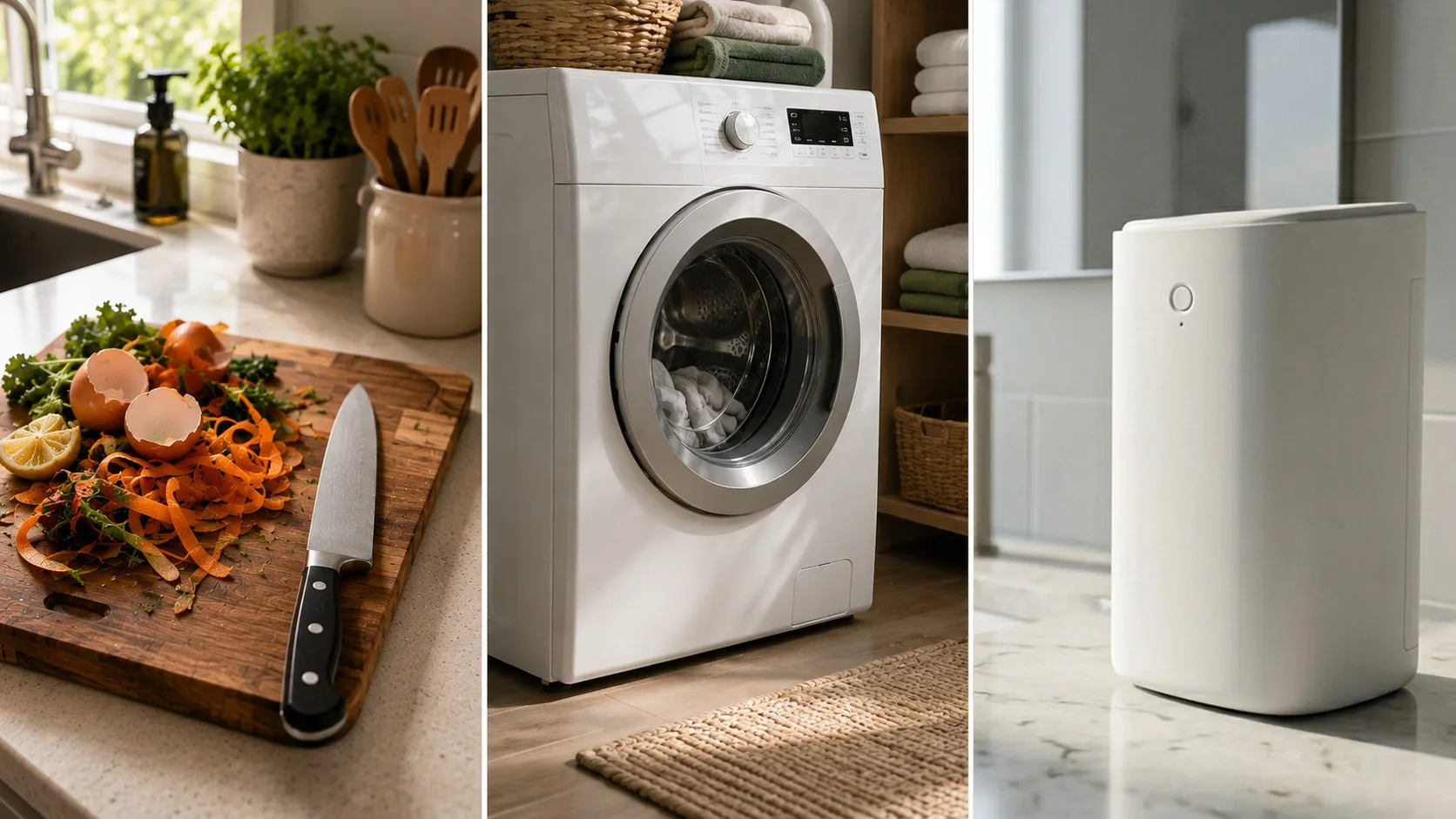
The Kitchen Counter
Mill makes a countertop bin that sits where a trash can used to sit. Food scraps go in the same way they always did, no separate container, no rinsing, no sorting meat from vegetables. Overnight, the bin dries and grinds everything down, shrinking the volume by roughly 80%. When it fills up, which takes weeks instead of days, the dried grounds get boxed up and mailed back. Mill turns them into ingredients for chicken feed instead of letting them rot in a landfill.
Mill didn't ask anyone to start a compost pile or learn what counts as "compostable." It replaced the one container everyone already uses, at the exact moment food waste is created.
The Bathroom Drawer
Suri builds an electric toothbrush around a head that gets replaced every two to three months, made from cornstarch and castor oil instead of the mixed plastics that make most toothbrush heads impossible to recycle. Every order ships with a prepaid, compostable mailer bag. Once three or four used heads have piled up, the bag gets sealed and dropped in any mailbox. Suri separates the bristles and metal clips, then heats and presses the plant-based material into pellets that become new heads, or products like soap dishes.
Suri has reported that roughly 35% of customers actually send their heads back. That's not everyone, but it's far higher than the return rate on a typical toothbrush recycling program that requires finding a drop-off location. The return path ships with the product itself, at the exact moment the old head comes off.
The Bathroom Counter
This is where LensLoop lives. A small recovery unit sits right where a contact lens actually comes out, at the sink, in the two seconds between removing a lens and reaching for the trash can. No sorting, no rinsing, no separate bin to remember. The lens and its packaging go straight in, and every capture earns Blister Bucks toward the next order.
What These Systems Have in Common
Line these systems up, including PlanetCare's, and the pattern isn't the product category. It's where the recovery point sits, relative to the moment the waste is created. The economics behind why landfill wins by default aren't a mystery either, once you look at them.
| Attribute | Traditional Drop-Off Recycling | Mill / Suri / LensLoop |
|---|---|---|
| Where recovery happens | A separate location, visited later | The exact spot the waste is created |
| Requires remembering | Yes, often for weeks | No, it is built into the routine |
| Requires sorting or rinsing | Usually, before drop-off | No |
| Return logistics | The person's responsibility | Handled by the company |
| Typical participation | Well under 1% of eligible material | 35% to 93%, depending on the system |
"Every system on this list works for the same reason. It doesn't ask anyone to remember, sort, or travel. It simply sits at the place the waste happens."
How We Landed on the Same Idea
Before LensLoop, we ran Sightly, a platform that let eye care practices sell contact lenses directly to their own patients instead of losing them to online retailers. Over 10,000 patients ordered through it.
Running that business taught us two things that had nothing to do with recycling at first. The garbage can is the real competitor. Any recovery system that is harder to use than throwing something away will lose, no matter how good the intentions behind it are. Because we already knew when a patient's next order was shipping, we already knew exactly when their old lenses were about to run out.
Put those two things together and the conclusion is obvious in hindsight. Waste collection has to happen in the bathroom, where the waste is actually created, and it has to line up with the timing of the next order rather than a separate errand the person has to plan. That's the whole idea behind LensLoop: order, use, recover, on a loop that doesn't ask anyone to think about it.
Mill didn't come from contact lenses. Suri didn't come from eye care. Neither did PlanetCare, and neither did we. All of us still built the same shape of solution, because the problem itself has the same shape everywhere it shows up. Waste gets left behind at the exact place it's created, so recovery has to happen there too.
Our first cohort has been living with this system for 18 months now. What they told us matches everything above: it stopped feeling like a chore once it stopped requiring a decision.
We've proven the capture rate. Now we need the scale.
14 billion lenses get thrown away every year in the US. We've shown that 93% of them don't have to be — if the recovery system is in the right place at the right time. What we need now is more people in the system to prove it holds.
If you wear contact lenses, this is the simplest thing you can do. Join the waitlist. When we're ready to ship, you'll be first.
No commitment. You'll be the first to know when we open.
Frequently Asked Questions
What is point-of-use recovery?
Point-of-use recovery means capturing waste at the exact location and moment it's created, instead of asking someone to store it and travel to a drop-off point later. A kitchen bin that processes food scraps while cooking is point-of-use. A recycling center across town isn't.
Is LensLoop affiliated with Mill or Suri?
No. LensLoop has no partnership with Mill or Suri, or with PlanetCare, which we've written about separately. This article points out a shared design pattern across independent companies that arrived at it from different starting points, not a collaboration between them.
Why do mail-back and drop-off recycling programs get such low participation?
Mail-back and drop-off programs ask people to remember, store, and travel with their waste. Each of those steps loses participants. Systems that capture waste automatically, at the moment it's created, don't depend on memory or motivation to work, which is why their participation rates run so much higher.
What is LensLoop?
LensLoop is a home-based contact lens waste recovery system built around Point-of-Use Recovery. It combines a lens subscription with a bathroom-based recovery unit and a companion app, so recovery happens as part of a routine the wearer already has, with no sorting, storage, or dedicated trip required. A beta program achieved a 93% per-user capture rate. LensLoop is currently expanding its user base and accepts waitlist registrations at getlensloop.com.
Sources & References
- Mill (2026). Food Recycler product overview. [80% overnight scrap volume reduction; countertop mail-back cycle.] mill.com
- Modern Retail (2026). Suri got shoppers on board with recycling toothbrush heads. Now, it is turning them into soap dishes. [35% customer return rate on used brush heads.] modernretail.co
- SURI (2026). How we recycle our plant-based heads. [Prepaid mailer bag return process; material separation and pelletizing.] trysuri.com
- LensLoop (2026). Beta program results: 18-month point-of-use recovery pilot. Internal data. [93% capture rate; 2,316 units recovered.]
- LensLoop (2026). Contact Lens Waste: Why Recycling Programs Keep Failing. getlensloop.com
- LensLoop (2026). Why Products That Fit Your Routine Win. [PlanetCare 98% microfiber capture rate; routine-integration framing.] getlensloop.com
- Eyes on Eyecare (2025). 2025 Contact Lens Industry Report. [14B annual US discards.] eyesoneyecare.com