
Key Takeaways
"1,243 soft contact lens wearers across 16 countries. Most throw blister packs in the general waste bin — not because it's the right answer, but because it's the default. Only 9.6% flush lenses, which is the behavior that causes the most harm."
"The strongest predictor of correct disposal isn't how much someone cares about the environment. It's whether they feel they can actually do it easily. Perceived personal control is roughly four times more influential than attitude alone."
"Nearly half of all wearers surveyed had never been reminded by their eye care provider about proper disposal. The infrastructure to act on good intentions, at the moment waste is created, doesn't exist yet."
What Lens Wearers Are Actually Doing
We talk a lot about the scale of contact lens waste. The 14 billion lenses discarded every year in the US alone. The blister packs. The foil. The cardboard. But what do lens wearers actually think about all of this? And what are they actually doing when they toss that blister pack after their morning routine?
A team of researchers set out to answer exactly that. The result is one of the most thorough looks at contact lens disposal behavior ever published, and the findings tell a story that's more complicated than you might expect.
The Study
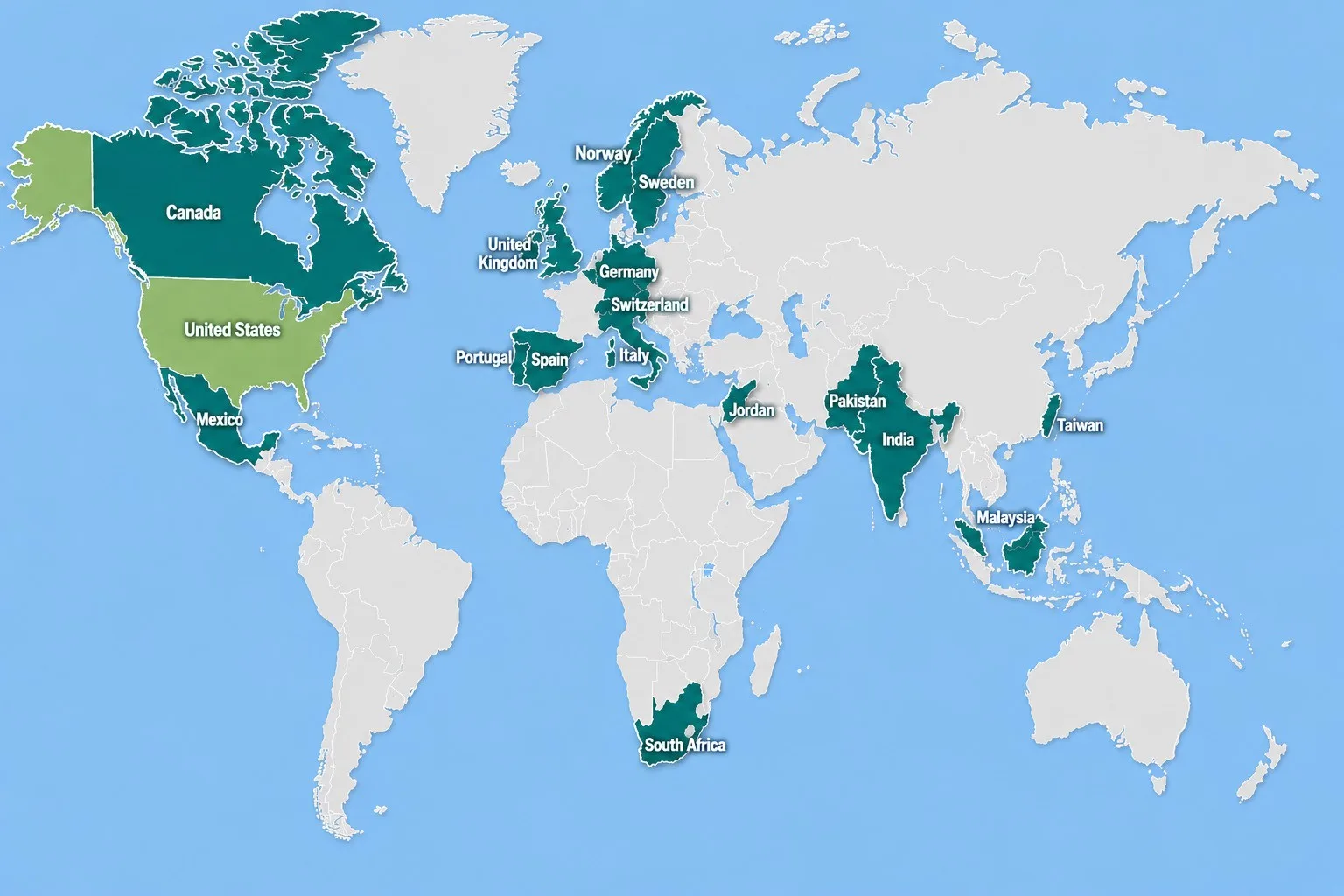
Dr. Fabrizio Zeri, a researcher at the University of Milano-Bicocca and Aston University, led an international team of optometry and behavioral science researchers across 21 institutions to survey soft contact lens wearers in 16 countries. The countries included Canada, Germany, India, Italy, Jordan, Malaysia, Mexico, Norway, Pakistan, Portugal, South Africa, Spain, Sweden, Switzerland, Taiwan, and the United Kingdom, plus additional participants from elsewhere.
The survey gathered data on how people dispose of their contact lenses and packaging (the blister packs, cardboard boxes, and foil lids), how often they do it correctly, what they think the right behavior is, and what beliefs and social factors predict whether they'll actually follow through. It also drew on a behavioral framework called the Integrated Behavioral Model, developed by Daniel Montano and Diane Kasprzyk, to understand what drives real-world behavior versus stated intention.
The results were presented at the British Contact Lens Association's 2025 annual meeting.
What They Found
Start with what the study actually proves about defaults. Most contact lens wearers throw their lenses in the general waste bin — 75.5% do it often or always. But that's not a recycling win. There's no consumer recycling stream for the lenses themselves, so the bin is simply what's in front of them. The study didn't find that people are making a conscious, considered choice. It found that they're doing what requires zero effort. The default wins. Only 9.6% were sending lenses down the drain frequently, and that's where the real environmental harm starts — microplastics entering the wastewater system.
That's better than older data suggested. A 2020 study by Charles Rolsky, Varun Kelkar, and Rolf Halden at Arizona State University had estimated that around 21% of Arizona lens wearers were flushing lenses, contributing to microplastic pollution in wastewater systems. This new international survey puts that figure lower, at least among its sample.
"75% of lens wearers use the general waste bin — not because it's the right answer, but because it's the default. This study is evidence that people do whatever requires the least effort. Build the right behavior into the default, and the behavior changes."
Now here's where it gets complicated. When you look at packaging, the picture changes fast.
Cardboard packaging fared reasonably well: 59.8% of wearers reported often or always putting it in the paper recycling bin. Not perfect, but directionally right.
Blister packs were a different story. Only 31.7% of wearers reported often or always putting blister packs in the plastic recycling bin. That means the majority of blister packs are still going into general waste, and in most municipalities, that means landfill.
Foil lids were the lowest of all. Only 13.2% of wearers were regularly putting foil lids in an aluminum recycling bin. The majority, 64.8%, said they often or always threw foil in the general waste bin.
They Know Better — That's the Problem
Here's what makes this survey different from a standard waste audit. The researchers didn't just measure behavior. They measured knowledge and belief alongside it.
Most lens wearers know that blister packs should go in the recycling. They just don't do it consistently. That gap between knowing the right behavior and actually doing it is exactly what behavioral scientists study, and Dr. Zeri's team ran a hierarchical regression analysis to figure out what predicts the intention to dispose correctly.
Three factors from the Integrated Behavioral Model explained the variance well. The model accounted for 47% of the variance in stated disposal intention (R² = 0.47, p < 0.01). The three predictors were:
- Attitudes toward the behavior — whether the person genuinely believes disposing correctly is good and important
- Perceived social norms — whether the person thinks others around them are disposing correctly
- Perceived personal control — whether the person feels they actually can do it easily
Of the three, perceived personal control had by far the strongest influence. It was roughly four times more predictive of disposal behavior than attitude alone. Social norms fell in the middle. In plain terms: it doesn't matter much how strongly someone believes recycling is important if they don't feel they can actually do it. The feeling of "I can" does more work than the feeling of "I should."
p < 0.001 means the researchers are highly confident the result isn't a statistical fluke. All three factors cleared this bar, so all three are real and meaningful — perceived control just matters most.
Source: hierarchical regression analysis, Zeri et al., BCLA 2025. R² = 0.47, meaning these three factors together explain 47% of the variance in disposal intention.
"The strongest predictor of correct disposal isn't how much someone cares about the environment. It's whether they feel they can actually do it. Perceived control over the behavior matters more than attitude."
That's a meaningful distinction. It shifts the question from "how do we convince people to care more?" to "how do we make the right behavior feel easy and within reach?"
The Role Eye Care Professionals Are Missing
The survey also asked how often eye care professionals remind patients about proper disposal. Nearly half of respondents, 48.2%, said they had never been reminded by their eye care provider. Another 15.9% said rarely. That's nearly two thirds of lens wearers receiving no guidance from the person best positioned to give it.
The researchers were direct about this. Eye care professionals have a significant opportunity to shift behavior by reinforcing proper disposal at the point of care, and most of them aren't taking it. Given the finding that perceived norms drive behavior, hearing from your optometrist that "this is what responsible lens wearers do" could move the needle more than any public campaign.
What This Actually Means
Here's what we take away from this research.
Lens wearers aren't lazy or indifferent. The majority dispose of the lenses themselves correctly. When you ask them whether proper disposal matters to them, most say yes. The problem isn't motivation.
The problem is that the system asks them to do something complicated at a moment when they're standing at a bathroom sink, half awake, on their way to something else. Sort your lenses from your blister packs. Sort your blister packs from your foil. Know which recycling bin is which. Keep it all separate.
That's friction. Friction, as anyone who studies behavior will tell you, kills follow-through, even when intent is high.
"Intent to recycle is widespread among contact lens wearers. The infrastructure to act on that intent, at the moment the waste is created, doesn't exist yet."
The existing solution to this problem is drop-off recycling. The ONE by ONE Recycling Program, run by Bausch + Lomb in partnership with TerraCycle, has been operating since 2016. As of April 2026, it has recovered around 725,000 lbs of material across more than 119 million units. That's a genuine achievement. It's still recovering well under 1% of the approximately 14 billion lenses discarded in the US every year.
The reason isn't that people don't care. Dr. Zeri and colleagues just showed us that most of them do. The reason is that storing waste and driving to a drop-off location requires effort that doesn't match the moment when the waste is created. You throw a blister pack away in the bathroom on a Tuesday morning. The drop-off bin is somewhere else, and you have to remember it's there.
Where LensLoop Fits
This is the problem we built LensLoop to solve.
Before founding LensLoop, our team ran Sightly, a platform that gave eye care practices their own online storefronts so patients could order lenses directly through their doctor instead of through a mass-market retailer. We had over 10,000 patients ordering through it. Through that work, we learned two things that changed how we thought about contact lens waste.
First: the garbage can wins because it's always there. Any recovery system that requires more effort than throwing something away will lose to the garbage can, not because people don't care, but because the garbage can is frictionless and the recovery system isn't.
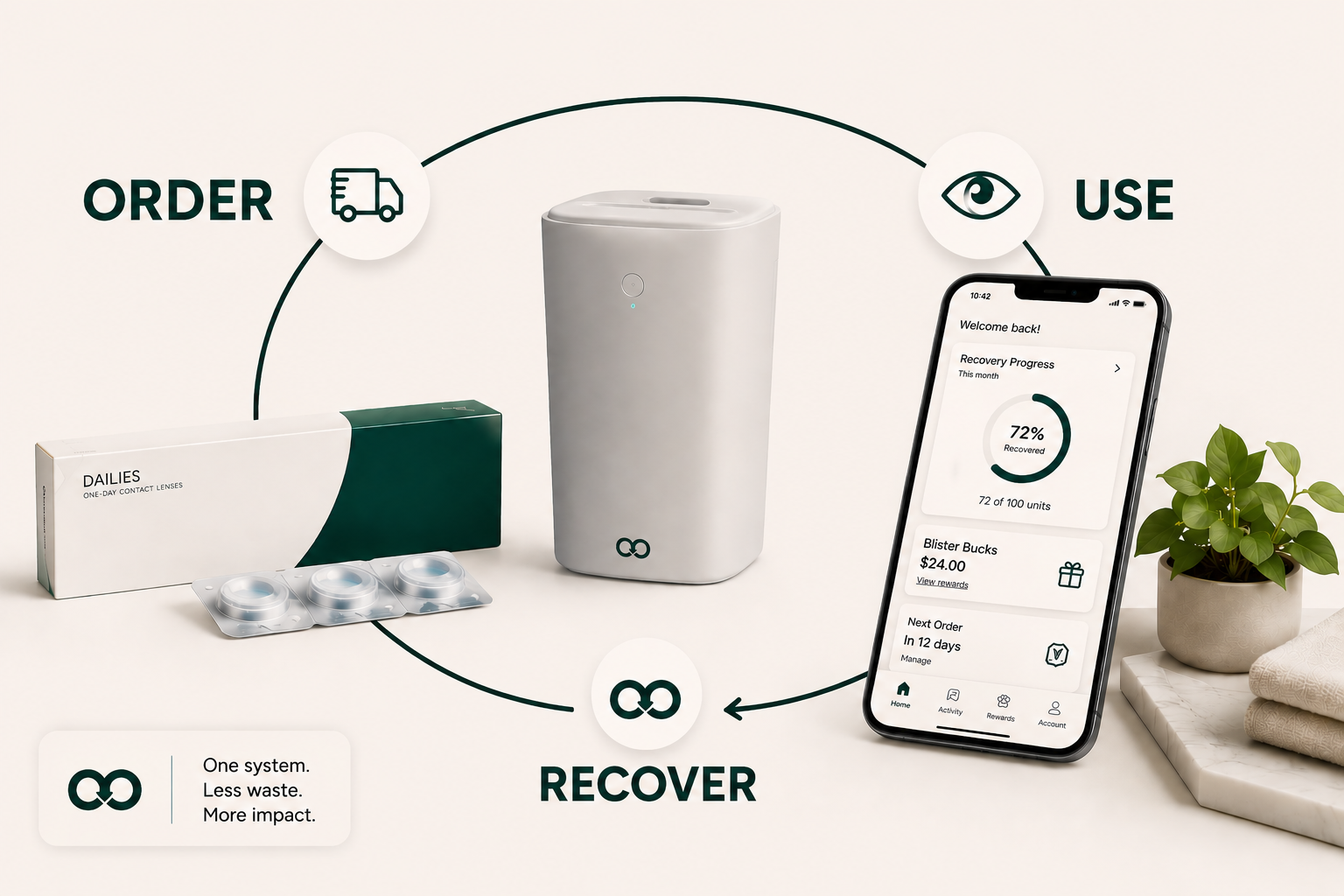
Second: through Sightly, we knew when every patient's next order was about to ship. If you know when someone runs out of lenses, you know exactly when they've generated a full cycle's worth of waste. You know when to collect it.
That's the logic behind LensLoop. Recovery has to happen in the bathroom, where the waste is created. Collection timing has to align with the supply cycle, so waste is picked up when lenses arrive.
We ran an 18-month closed beta. Not a survey. Not a model. Real units, in real bathrooms, with real lens wearers. We physically counted the waste that came back.
We recovered 2,316 units at a 93% per-user capture rate.
The 7% that didn't come back was travel, illness, time away from home. That's the real ceiling of a bathroom-based system, and it's still dramatically higher than what drop-off programs achieve in practice.
Dr. Zeri's study confirms something we've believed from the start: the audience for LensLoop isn't a niche group of environmental enthusiasts. It's the majority of lens wearers, who already want to dispose correctly and just need the right system to make it easy.
They have the intent. We built the infrastructure.

We've proven the capture rate. Now we need the scale.
14 billion lenses get thrown away every year in the US. We've shown that 93% of them don't have to be — if the recovery system is in the right place at the right time. What we need now is more people in the system to prove it holds.
If you wear contact lenses, this is the simplest thing you can do. Join the waitlist. When we're ready to ship, you'll be first.
No commitment. You'll be the first to know when we open.
Frequently Asked Questions
What did the international contact lens disposal survey find?
Researchers led by Dr. Fabrizio Zeri at the University of Milano-Bicocca surveyed 1,243 soft contact lens wearers across 16 countries. They found that most wearers dispose of their lenses correctly in general waste, but blister pack recycling rates are low — only 31.7% regularly put blister packs in a plastic recycling bin, and only 13.2% recycle foil lids in an aluminum bin.
Why do so few contact lens wearers recycle their packaging?
The study found that the biggest predictor of correct disposal is perceived personal control — whether someone feels they can actually do it easily. Lack of convenient infrastructure, not lack of interest, is the main barrier. Nearly half of wearers had never been reminded about proper disposal by their eye care provider.
How does LensLoop improve on existing contact lens recycling programs?
Existing programs like ONE by ONE require consumers to store waste and travel to a drop-off location. LensLoop places a recovery unit in the bathroom, where waste is created. Its beta achieved a 93% per-user capture rate over 18 months. Current drop-off programs recover well under 1% of annual US contact lens discards.
Where can I find best-practice guidance for recycling contact lenses in my country?
Recycling capabilities vary significantly by region. Dr. Zeri's research team recommends visiting the Euromcontact website at euromcontact.org for location-specific disposal guidance.
Sources & References
- Zeri, F., Shinde, L., Naroo, S., Woods, C.A., Aakre, B.M., Arshad, M., Bakkar, M., Barodawala, F.S., Carrillo, G., Chetty, E., Dominguez-Vicent, A., Liaw, H., Lira, M., Livi, S., Martinet, L.A., Marx, S., Nosch, D., Jones, D., Ruiz-Alcocer, J., Santoro, C., Steca, P., & Tavazzi, S. (2025). CL sustainability behaviours among soft CL wearers: an international survey. Poster presented at the British Contact Lens Association (BCLA) Annual Conference, 2025. [1,243 participants; 16 countries; disposal behavior and IBM regression data.]
- Rolsky, C., Kelkar, V.P., & Halden, R.U. (2020). Nationwide mass inventory and degradation assessment of plastic contact lenses in US wastewater. Environmental Science & Technology, 54(19), 12102–12108. [21% Arizona wearers flushing lenses estimate.] https://doi.org/10.1021/acs.est.0c03963
- Montano, D.E., & Kasprzyk, D. (2015). Theory of reasoned action, theory of planned behavior, and the integrated behavioral model. In K. Glanz, B.K. Rimer, & K. Viswanath (Eds.), Health Behavior: Theory, Research and Practice (5th ed., pp. 95–124). Jossey-Bass. [Integrated Behavioral Model framework.]
- LensLoop (2026). Beta program results: 18-month point-of-use recovery pilot. Internal data. [93% capture rate.]