
Key Takeaways
"Norway recycles 97% of its plastic bottles. Denmark hits 93%. The gap between those numbers and the 30–50% typical of curbside recycling isn't explained by better facilities or more awareness campaigns. It's explained by one thing: a deposit."
"A deposit return system turns packaging from waste into asset. Every container you don't return is money you've already spent and don't get back. That shift in incentive — from abstract environmental appeal to immediate personal reward — is the whole mechanism."
"LensLoop applied the same logic to contact lens packaging. Users with the system in their bathrooms achieved a 93% per-user capture rate over 18 months — not because they're unusually dedicated, but because the system made returning the default behaviour and made that default financially rewarding."
The Number That Changes Everything
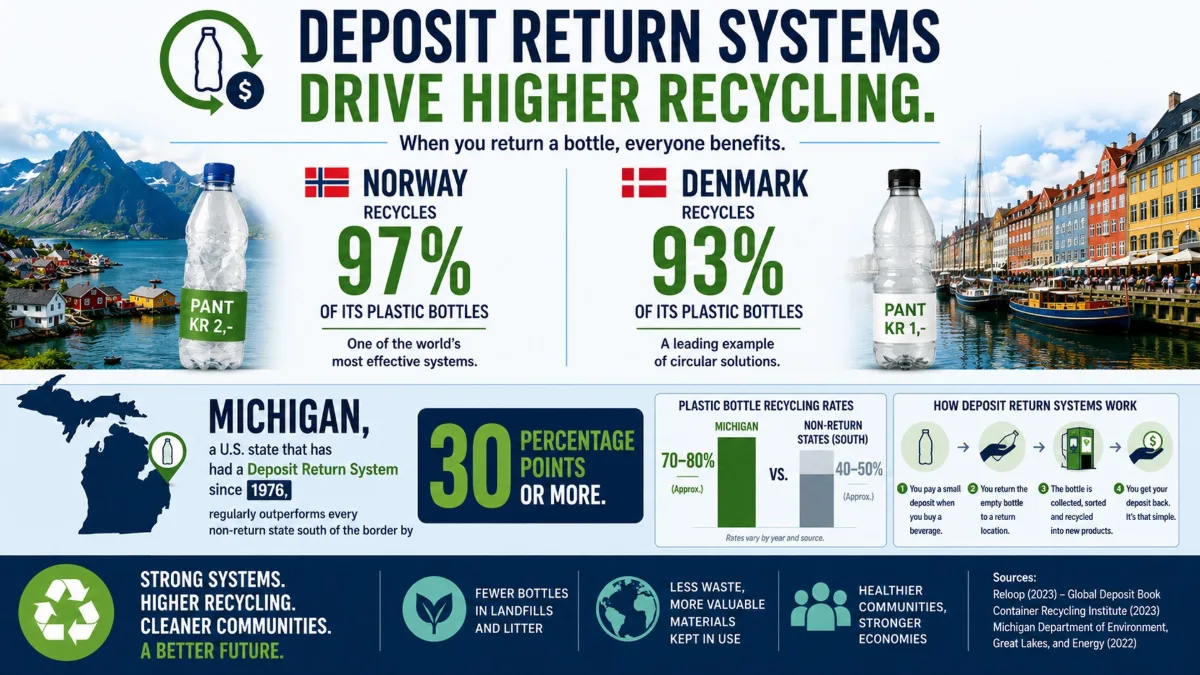
Norway recycles 97% of its plastic bottles. Denmark hits 93%. Michigan, a U.S. state that has had a bottle deposit law since 1976, regularly outperforms every non-deposit state south of the border by 30 percentage points or more.
These aren't outliers. They're what consistently happens when you attach a small refundable deposit to a piece of packaging.
The logic is straightforward. When throwing something away has a financial cost, behaviour changes. When returning something comes with a financial reward, it changes even more. That shift in incentive is the whole mechanism. Everything else is execution.
What a Deposit Return System Actually Does
Traditional curbside recycling typically plateaus between 30% and 50% capture rates. That number has barely moved in decades. The limiting factor isn't infrastructure. It's motivation. Curbside is convenient, but there's no direct personal reward for using it correctly. You sort, you put out the bin, nothing immediately happens for you.
A deposit changes that equation completely. Every container you don't return is money you've already spent and don't get back. Every container you do return puts cash in your pocket. The packaging goes from waste to asset in a single policy decision.
The gap between those two sets of numbers isn't explained by better facilities or education campaigns. It's explained by one thing: the deposit gives the individual a personal, immediate, financial reason to act.
It's Not Just the Volume. It's the Quality.
High recycling rates matter. There's a second benefit to deposit systems that gets less attention, though: the material quality is dramatically better.
Mixed-stream curbside collection suffers from cross-contamination. Food residue, wrong materials, broken glass — it all ends up together, and a significant portion gets lost in sorting and cleaning. The result is often a lower-grade material that can't go back into food-grade packaging. It gets downcycled into something less valuable, or rejected entirely.
Deposit systems work differently. Containers are returned separately, not mixed with household waste. The material arrives clean and sorted. PET plastic and aluminium go directly back into food-grade containers. That's true closed-loop recycling, not a slow downgrade to parking cones and fleece.
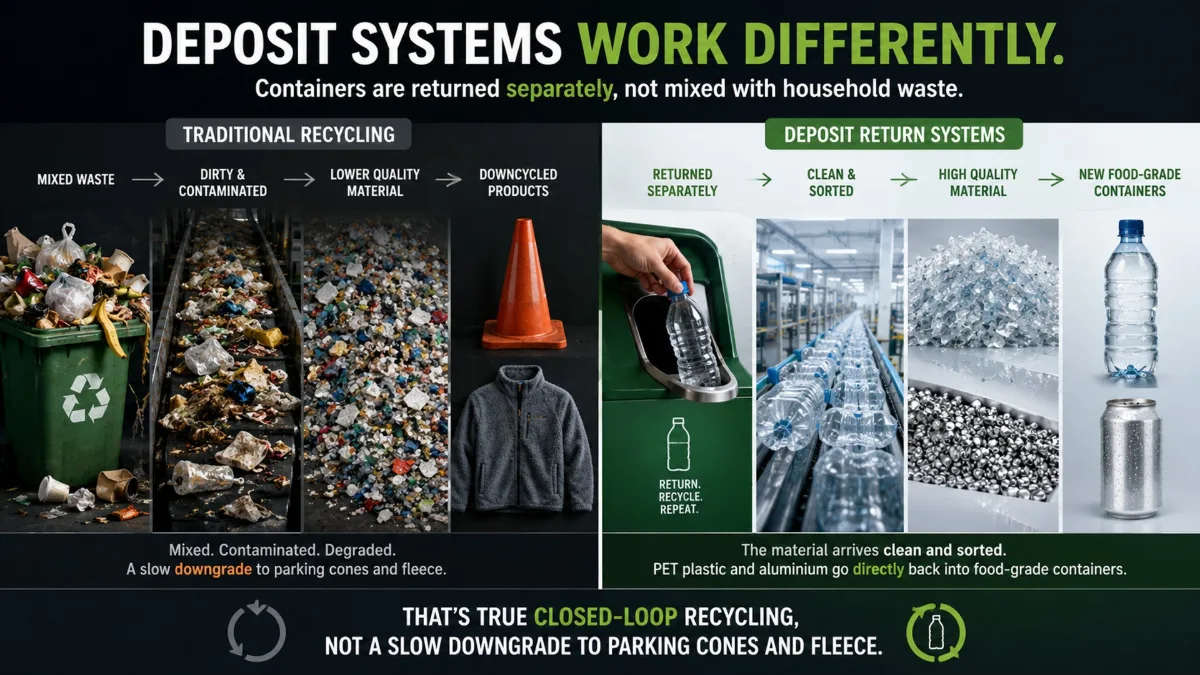
"Deposit systems don't just recover more material. They recover better material — clean, separated, and ready for closed-loop recycling back into the same product."
The Side Effects That Don't Get Enough Credit
When every container has cash value, people stop leaving them behind. DRS programmes consistently reduce litter in public spaces, along roadways, and in waterways. If you spot a bottle worth 10 cents, you pick it up. The deposit functions as a crowd-sourced cleanup incentive.
There's also a shift in who pays for waste management. Traditional municipal systems put cleanup costs on local governments, and through taxes, on residents. Deposit systems redirect that financial burden toward producers and consumers of the packaging itself. The people who create the waste fund the recovery of it.
We Built This for Contact Lens Wearers
Contact lens packaging is a different problem than beverage containers, but the core dynamic is the same. Most wearers say they'd recycle if they could. The packaging ends up in the trash anyway. Not because people don't care. Because there's no convenient system with a direct reward for using it.
We applied the deposit return logic to blister packs and built it into LensLoop. We call the reward BlisterBucks.
How BlisterBucks Work
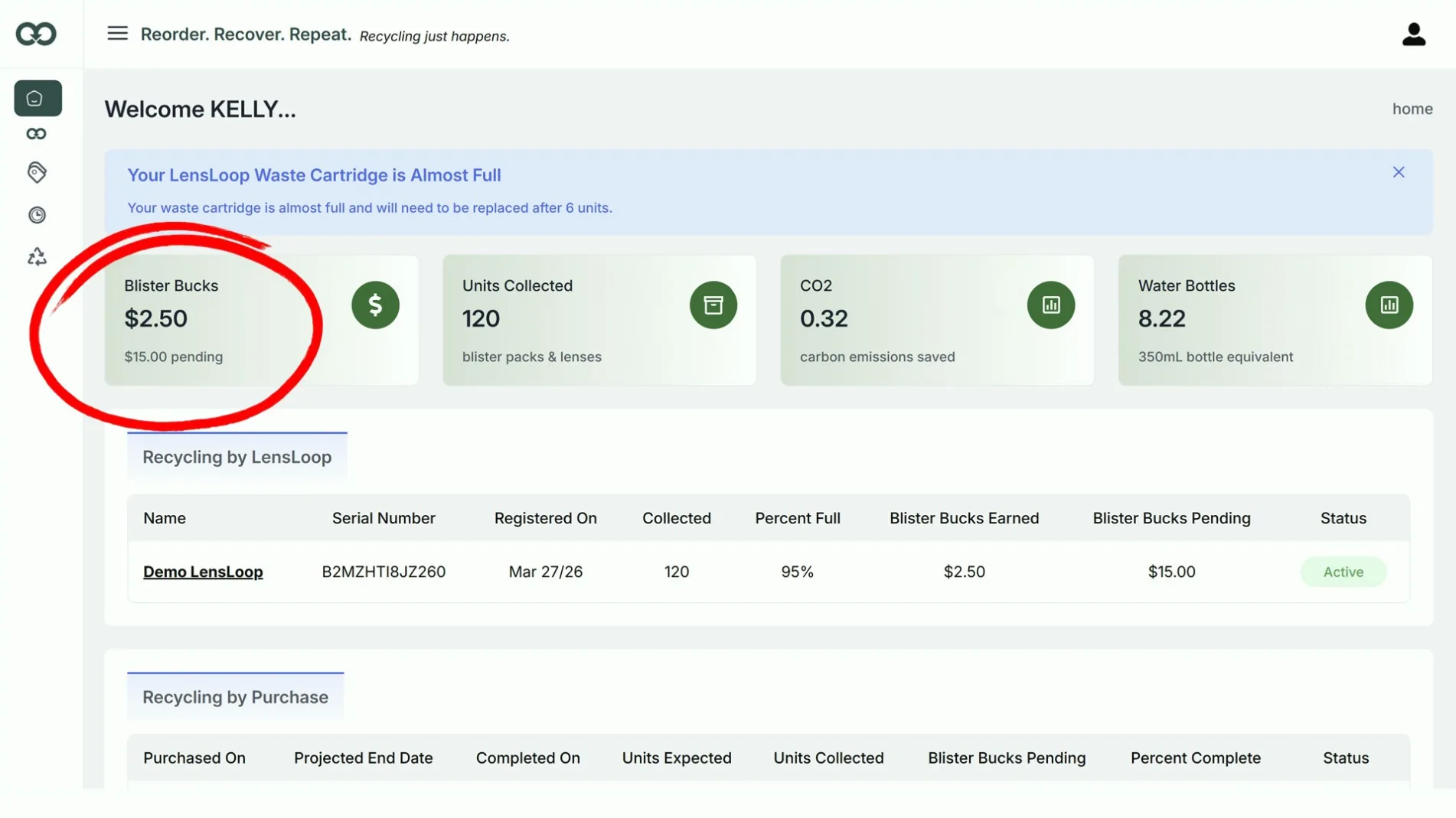
Every time you use your LensLoop and drop the foil and blister pack into the recovery unit, the system automatically rewards you with a pending BlisterBuck. No logging required. No batch submission. Each deposit earns immediately.
"Each time you deposit a blister pack, you earn a pending BlisterBuck. Return your cartridge, get it validated, and that pending balance becomes a real dollar discount on your next order."
The structure mirrors what makes deposit return systems effective. There's a direct, personal financial reward tied to the act of recovery itself, not to some future behaviour you have to remember. You recycle, you earn, it shows up in your account immediately.
LensLoop already knows when your next order is due, so the timing lines up. Return your waste, get your reward, receive your next supply. That cycle is the whole system.
Why Financial Incentives Work Where Appeals Don't
Research on deposit return systems keeps pointing to the same conclusion: people respond to immediate, tangible financial incentives far more reliably than to abstract environmental appeals. That's not cynical. It's just how behaviour works.
Curbside recycling asks you to do something with no direct feedback and no personal upside. BlisterBucks ask you to do the same thing and put money back in your pocket with every deposit. That difference in reward structure explains the difference in participation rates.
Our beta ran for 18 months. Users who had the LensLoop system in their bathrooms achieved a 93% per-user capture rate. That sits in the same range as Denmark's national DRS programme. It's not because our users are unusually dedicated. It's because the system made returning the default behaviour, and made that default financially rewarding.
Make the right behaviour the easy behaviour. Make it the rewarding one too. That's the whole game.
We've proven the capture rate. Now we need the scale.
14 billion lenses get thrown away every year in the US. We've shown that 93% of them don't have to be — if the recovery system is in the right place at the right time. What we need now is more people in the system to prove it holds.
If you wear contact lenses, this is the simplest thing you can do. Join the waitlist. When we're ready to ship, you'll be first.
No commitment. You'll be the first to know when we open.
Frequently Asked Questions
What is a deposit return system (DRS)?
A deposit return system charges a small, refundable deposit on packaging at the point of purchase. The deposit is returned when the packaging is brought back to a designated collection point. It's not a tax — it's money the consumer already paid, waiting to be reclaimed when they do the right thing.
Why do deposit return systems have higher recycling rates than curbside programs?
Deposit systems attach a direct, personal financial reward to the act of returning packaging. Curbside recycling offers no immediate personal benefit, so participation plateaus at 30–50%. When a container has monetary value, people return it. Programs like Norway's DRS achieve 97% return rates as a direct result.
What are BlisterBucks?
BlisterBucks are LensLoop's recycling reward. Each time you drop a used blister pack and foil seal into your LensLoop recovery unit, you earn a pending BlisterBuck automatically. When your waste cartridge is returned and validated, those pending BlisterBucks become available as an instant rebate on your next contact lens purchase. Earning discounts for your recycling efforts.
How do I check my BlisterBucks balance?
Log in to your LensLoop dashboard. You'll see your total available BlisterBucks and how many are currently pending, waiting for your next cartridge return and validation.
When do my pending BlisterBucks become available?
Pending BlisterBucks become available once your waste cartridge is returned to LensLoop and validated. At that point, your pending balance is confirmed and you can apply it as a rebate on your next lens order.
What recycling rate did LensLoop achieve in its beta?
LensLoop achieved a 93% per-user capture rate over an 18-month beta. That compares directly to Denmark's national deposit return programme, which runs at 93% for beverage containers and far exceeds the 30–50% rates typical of curbside recycling.
Sources & References
- Association of Plastics Recyclers (APR). Bottle Deposit Laws Can Increase Plastics Recycling. plasticsrecycling.org
- Sensoneo. Positive Impact of Deposit Return Schemes. Global Waste Index. sensoneo.com
- TOMRA. Deposit Return Schemes. tomra.com
- Plastic Bank. Does the Deposit Return Scheme Work? plasticbank.com
- Reloop Platform. Key Factors Impacting DRS Performance. Fact Sheet, November 2025. reloopplatform.org
- Container Recycling Institute. Economic and Environmental Benefits of Deposit Systems in Washington State. 2004. container-recycling.org
- Bottle Bill Resource Guide. Benefits of Bottle Bills. bottlebill.org
- Efron, N. et al. Contact Lens Waste. Contact Lens & Anterior Eye, 2021. Elsevier.
- LensLoop. Internal Beta Data. 18-month closed beta, 2024–2026. getlensloop.com