

Key Takeaways
"US consumers discard an estimated 14 billion individual contact lenses every year. Less than 1% enter a recovery system, despite a decade of dedicated recycling programs. The bottleneck is behavioral, not technological."
"Just 10 daily contact lens wearers generate enough blister pack waste in a single year to fill a standard bathtub. 7,244 units. The waste is invisible in daily life only because each piece disappears in two seconds. The aggregate does not disappear."
"The LensLoop beta achieved a 93% per-user capture rate over 18 months and 2,316 recovered units. It demonstrates that point-of-use recovery produces fundamentally different participation outcomes than drop-off alternatives."
"64% of daily disposable lens waste by mass is polypropylene blister trays, a recyclable material that is almost universally landfilled because no recovery system exists at the moment and location it is discarded."
"The shift to daily disposables, now 53%+ of new US fits, multiplies per-wearer packaging waste 30× versus monthly lenses. US consumers discard an estimated 14 billion individual lenses annually, and recovery infrastructure has not scaled alongside adoption."
The Scale of the Problem: By the Numbers
Here's the thing about contact lens waste: it doesn't look like a problem. Each blister pack is the size of a coin. You use it, you toss it, you move on. It's gone in two seconds, and that's exactly what makes the scale so easy to miss.
If you wear daily disposables, the math works out to 730 lenses a year. That's 730 plastic blister packs and 730 foil seals, about a kilogram of packaging waste, just from you. Switch to bi-weeklies and that drops to 52 lens units. Monthly wearers? Just 24. The move toward dailies is what's compounding the problem, and they're now the majority of new prescriptions. 64% of that waste by mass is polypropylene plastic that could technically be recycled. Almost none of it is.
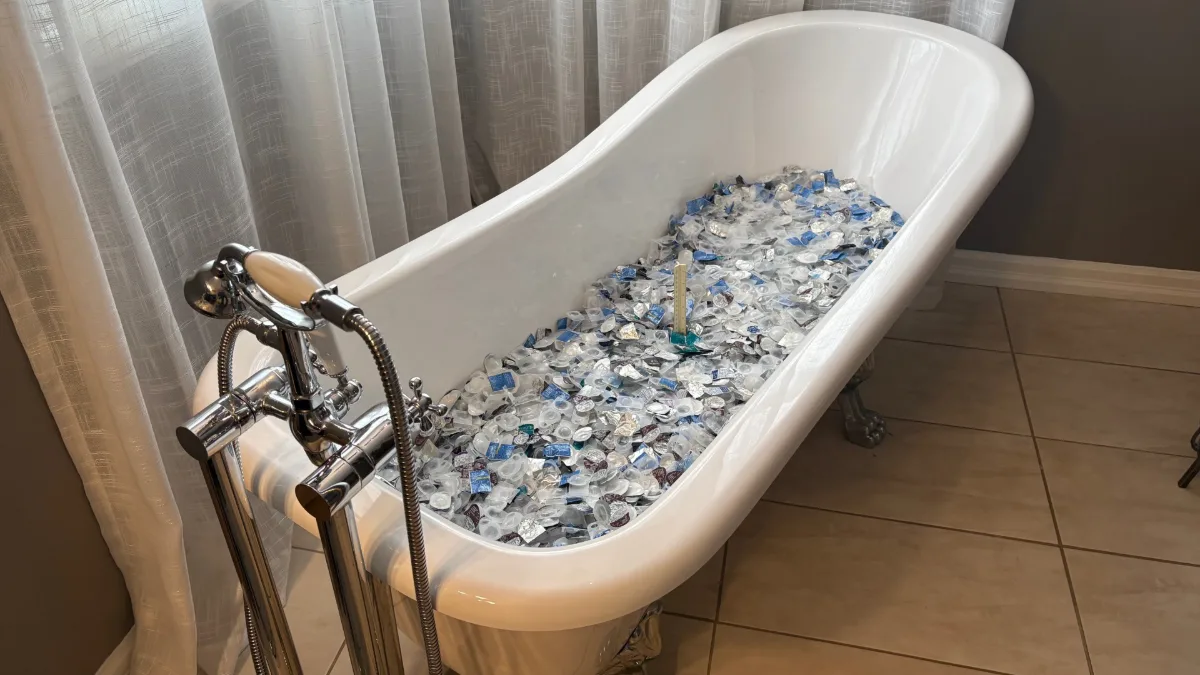
That's a bathtub full of 7,244 used contact lens blister packs. We collected and counted every one. It's what 10 daily lens wearers throw away in a single year. Each pack disappears in two seconds. Together, they fill a bathtub.
There's also the flushing problem. About 19% of US contact lens users rinse their lenses down the sink or flush them down the toilet. Those lenses don't dissolve, they break apart inside wastewater treatment systems into microplastic fragments too small for standard filters to catch. They end up in rivers, lakes, and oceans, where they accumulate in sediment and get consumed by fish.
Key Terms: A Vocabulary for the Contact Lens Waste Problem
Why Contact Lens Recycling Programs Struggle to Scale
The recycling technology exists. Programs have been running for close to a decade, and the materials, polypropylene, aluminum foil, hydrogel, all have viable recovery pathways. So why is less than 1% of this waste actually getting recovered?
The easy answer is that people don't care enough. That's not what's happening. Most contact lens wearers, when you ask them, say they want to recycle their packaging. The problem isn't caring. It's everything that has to happen between the bathroom and a drop-off bin.
"The real barrier to contact lens recycling is not awareness, concern, or technology. It is the gap between a bathroom and a drop-off bin, measured in steps, days, and decisions."
The Friction Ladder: What Drop-Off Programs Ask of Consumers
Think about what a drop-off program actually asks you to do:
Sources: TerraCycle program reporting, April 2026; Eyes on Eyecare 2025 Contact Lens Report
Recovery Model Comparison: Drop-Off vs. Mail-In vs. Point-of-Use
There are really three ways you can try to solve this. Each one takes a different position on where the friction lives and who should absorb it.
| Attribute | Drop-Off Program (e.g., ONE by ONE) |
Mail-In Program | Point-of-Use Recovery (LensLoop) |
|---|---|---|---|
| Where waste is intercepted | Eye care clinic / retailer | Home (mail prep) → depot | Bathroom, at moment of removal |
| Storage requirement | Yes, weeks to months | Yes, until box is full | None |
| Travel required | Yes, dedicated trip required | Drop-off to postal service | No |
| Brand restrictions | Program-specific | Program-specific | Materials-based (any brand) |
| Behavior change required | High (new system + trip) | Medium (boxing + mailing) | Minimal |
| Scales with daily volume | Limited by trip frequency | Limited by box volume | Daily capture |
| Current US availability | Yes (select locations) | Limited pilots | Early access / waitlist |
| Measured capture rate | <1% of annual stream | Not publicly reported at scale | 93% per-user. 18-month beta, 2,316 units |
What Real-World Beta Data Shows
We didn't just theorize about this. We ran it.
Over 18 months, we put the LensLoop system into real bathrooms and measured what actually happened. Not in a lab. Not in a survey. In people's daily routines, the same way they'd use it if they'd bought it.
93% means that out of every 100 blister packs, lenses, and foil seals a user generated, 93 were recovered instead of thrown away. The 7% we missed? Travel days, being sick, opening a pack at a hotel. That's the real ceiling of a bathroom-based system. It's still higher than any participation rate any existing program has achieved.
"The LensLoop beta achieved a 93% per-user capture rate over 18 months. Existing drop-off programs recover less than 1% of the total annual US waste stream. Both numbers reflect the same principle: recovery happens where and when you make it easiest."
We're now expanding to 20+ users. The question we're testing isn't whether the concept works — we have 18 months of data on that. It's whether 93% holds when you take it into a wider range of households, routines, and living situations. That's what this next phase answers.
What a 93% Capture Rate Means at Scale
Once you have a real capture rate, you can start running the math forward. Here's what 93% looks like at different user volumes, assuming daily disposable wearers generating 730 units per year.
| Users | Annual units generated | Units recovered at 93% | Approx. kg diverted |
|---|---|---|---|
| 20 (current cohort) | 14,600 | 13,578 | ~18.6 kg |
| 100 | 73,000 | 67,890 | ~93 kg |
| 1,000 | 730,000 | 678,900 | ~930 kg |
| 10,000 | 7,300,000 | 6,789,000 | ~9,300 kg |
| 100,000 | 73,000,000 | 67,890,000 | ~93 tonnes |
Why Behavior Change Is the Wrong Target
Most sustainability programs are built on the same assumption: if people understand the problem and care about it, they'll change what they do. That assumption is wrong, not because people are bad, but because that's just not how behavior actually works.
What drives behavior isn't motivation, it's defaults. Whatever requires the least effort is what people do, consistently, at scale, regardless of how strongly they believe in the alternative. That's not a character flaw. It's human nature, and it's been documented across decades of behavioral science research.
"Behavior change is the wrong unit of analysis for recycling programs. Infrastructure change is the right one. When the environment changes, behavior follows. Motivation stops being the bottleneck." Behavioral economics framework; see BJ Fogg, Tiny Habits (2019); Richard Thaler & Cass Sunstein, Nudge (2008)
Right now, the default for contact lens waste is the garbage can. That's where it goes without thinking. Every recycling program that requires extra steps, storage, sorting, a trip somewhere, is fighting that default. The default wins almost every time.
The default for contact lens waste is the trash. Every competing recovery option requires deliberate action against that default. That's why motivation and awareness campaigns have not moved recovery rates at scale.
Related Concepts in Behavioral Waste Recovery
- Choice architecture: designing decision environments so the easier choice is also the better one (Thaler & Sunstein, 2008)
- Status quo bias: the documented tendency to prefer the current state of affairs, making defaults disproportionately powerful
- Implementation intentions: behavior change is more likely when tied to specific cues ("when I remove my lens, I place it in X") rather than general intentions
- Habit stacking: attaching a new behavior to an existing daily habit to reduce cognitive load
- The Fogg Behavior Model: behavior occurs when motivation, ability, and a prompt converge simultaneously. Most recycling programs have the motivation and the prompt, but they fail on ability because the friction is too high
Why Daily Disposables Make This Urgent
Daily disposables solved a real problem for contact lens wearers: no cleaning, no cases, no maintenance, just open a pack and go. That convenience is why they've become the dominant modality, and more than half of all new US prescriptions are now dailies.
But every daily lens is a blister pack. A bi-weekly wearer generates 52 of those a year, a monthly wearer generates 24, and a daily wearer generates 730 — 30 times more packaging waste than a monthly wearer. As more people switch to dailies, the waste compounds, and the infrastructure hasn't kept up.
How LensLoop Works: Order, Use, Recover
Before LensLoop, I ran a company called Sightly. We built a platform that let eye care practices offer online contact lens ordering directly to their patients, same convenience as the big retailers, but through the patient's own doctor. At its peak, Sightly had over 10,000 patients ordering through it.
When I learned about the scale of contact lens waste, two things became immediately clear.
First: the garbage can is the real competitor. Any recovery system that's harder to use than throwing something away is going to lose. It has to be at least as easy, and ideally easier.
Second: through Sightly, I already knew when a patient's next lens order was going to ship. That timing is everything. If you know when someone is going to run out of lenses, you know exactly when to collect their waste.
The conclusion was straightforward: waste collection has to happen in the bathroom, where the waste is created, and it has to be timed with the delivery of new supply. That's the foundation of LensLoop.
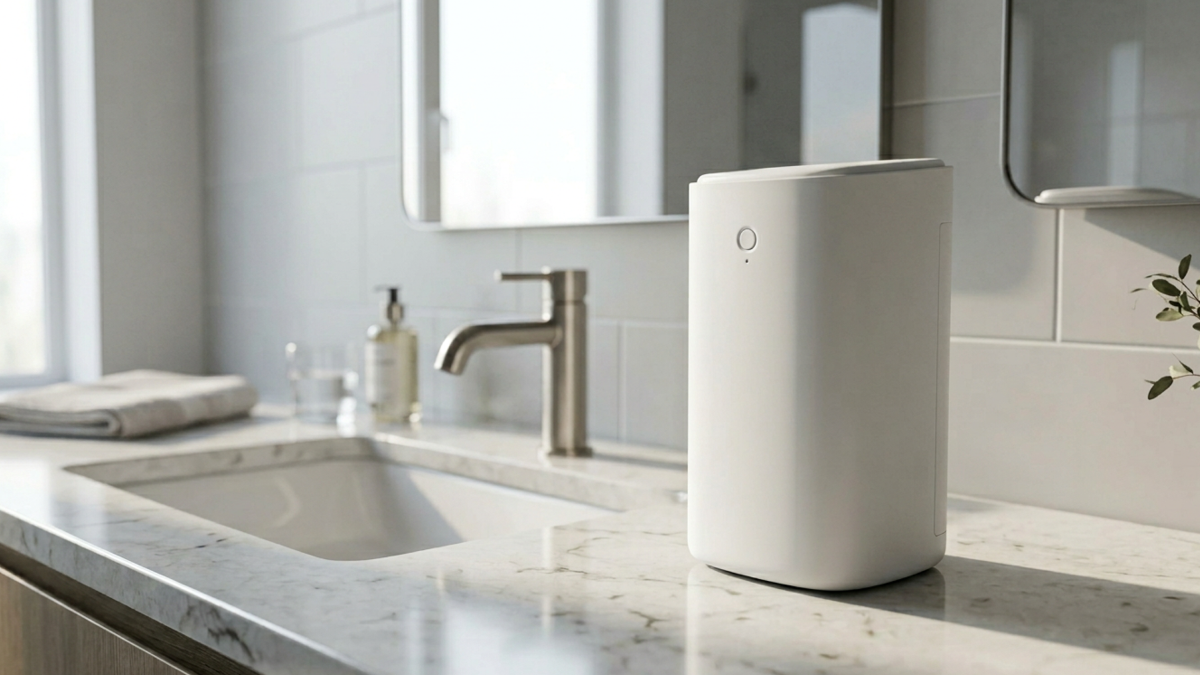
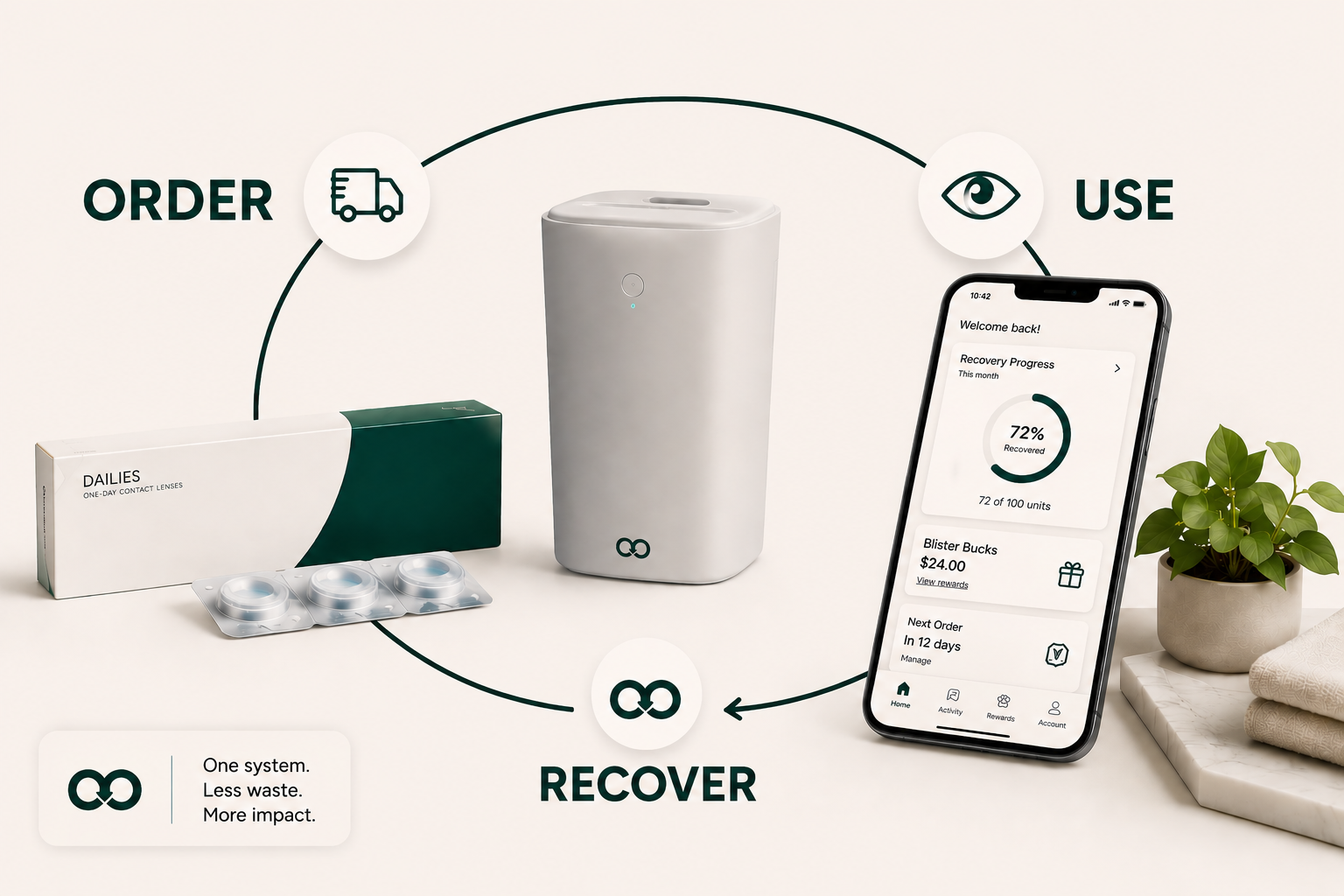
LensLoop is a single system, not a recycling program bolted onto a lens order, but both things built together from the start.
The result is that recovery is built into something the wearer was already going to do: order lenses. It's not an additional habit. It's a better version of the existing one.
"LensLoop merges the lens subscription and the recovery system into one loop. The user does not adopt a recycling habit. They continue their existing habit. The system captures the waste as a byproduct."
What the app tracks
One thing that's never existed for contact lens wearers is visibility into their own waste. You don't know how much you're generating. You definitely don't know how much of it got recovered.
The LensLoop app changes that. It shows units recovered this month, your running capture rate, Blister Bucks earned, and when your next order is due. Making the impact visible turns something invisible into something you can actually measure. That matters for keeping people engaged over time.
- Zero storage requirement: waste goes directly into the countertop unit at the moment it's created
- No extra trip: return logistics are managed by LensLoop
- No knowledge barrier: all lens waste from any brand goes into the same unit, no sorting rules
- Integrated with an existing purchase: recovery is part of the subscription, not a separate opt-in
- Transparent outcome: the app shows exactly what was recovered, building the feedback loop that sustains participation
We've proven the capture rate. Now we need the scale.
14 billion lenses get thrown away every year in the US. We've shown that 93% of them don't have to be — if the recovery system is in the right place at the right time. What we need now is more people in the system to prove it holds.
If you wear contact lenses, this is the simplest thing you can do. Join the waitlist. When we're ready to ship, you'll be first.
No commitment. You'll be the first to know when we open.
Frequently Asked Questions
Can you recycle contact lens blister packs?
Yes — but not through standard curbside recycling. Blister packs are made from polypropylene (the tray) and aluminum foil (the lid). Both materials are technically recyclable, but most municipal programs reject them because the items are too small for standard sorting equipment and are often contaminated with saline. Dedicated programs — primarily the Bausch + Lomb ONE by ONE program run with TerraCycle — accept them at participating eye care clinics and retailers. The limitation is not the material. It is the friction of getting the material to the program.
Why can't contact lenses go in the recycling bin?
Soft contact lenses are made from hydrogel or silicone hydrogel polymers — too small and lightweight for standard municipal recycling sorting equipment. They fall through processing gaps and end up landfilled. When flushed into wastewater systems, they fragment into microplastics. Without a specialist program, the safest disposal is to wrap lenses in tissue and place them in general waste — landfill is less harmful to waterways than flushing.
How much plastic waste does a daily contact lens wearer produce per year?
A full-time daily disposable lens wearer discards approximately 730 lenses, 730 plastic blister packs, and 730 aluminum foil seals annually — roughly 1 kilogram of packaging waste, with 64% by mass being polypropylene blister trays (Contact Lens & Anterior Eye). By comparison, bi-weekly wearers generate around 52 lens units annually, and monthly wearers around 24. Across the US, consumers discard an estimated 14 billion individual contact lenses every year (Eyes on Eyecare, 2025).
What happens to contact lenses that go down the drain?
Contact lenses that enter wastewater systems fragment into microplastic particles too small for standard treatment plant filters. A 2018 Arizona State University study published in Environmental Science & Technology estimated approximately 44,000 pounds of plastic from contact lenses enters US waterways annually via flushing. These particles accumulate in sediment and are consumed by aquatic life.
What is Point-of-Use Recovery for contact lenses?
Point-of-Use Recovery (PoUR) places recovery infrastructure at the exact moment and location waste is generated — rather than requiring consumers to store, transport, and deliver waste later. For contact lenses, this means bathroom-based systems integrated into the daily lens removal routine. The goal is to make recovery the default action, so participation does not depend on sustained motivation or deliberate behavior change.
What are the existing contact lens recycling programs in the US?
The primary program is the Bausch + Lomb ONE by ONE Recycling Program, launched in 2016 with TerraCycle. As of April 2026, it had recovered nearly 725,000 pounds of contact lens waste — more than 119 million units — from participating eye care clinics and retailers. All current programs require consumers to travel to a drop-off site, which limits participation.
What is LensLoop?
LensLoop is a home-based contact lens waste recovery system built around Point-of-Use Recovery. It combines a lens subscription with a bathroom-based recovery unit and a companion app — so that recovery happens as part of the routine the wearer already has, with no additional storage, travel, or deliberate behavior change required. A beta program has achieved a 93% unit capture rate. LensLoop is currently expanding its user base and accepts waitlist registrations at getlensloop.com.
Sources & References
- Rolsky, C., & Halden, R. U. (2018). Microplastic contamination of US waterways from contact lens disposal. Environmental Science & Technology. Arizona State University. [44,000 lbs / wastewater estimate.]
- Efron, N., et al. (2021). Waste composition data. Contact Lens & Anterior Eye. [64% blister tray waste by mass figure.]
- CDC (2024). Contact Lens–Related Eye Infections. US Centers for Disease Control and Prevention. [40.9 million US wearer estimate.]
- TerraCycle / Bausch + Lomb (2026, April). ONE by ONE Recycling Program recovery reporting. [725,000 lbs / 119M units recovered.]
- Thaler, R. H., & Sunstein, C. R. (2008). Nudge. Yale University Press. [Choice architecture and defaults.]
- Fogg, B. J. (2019). Tiny Habits. Houghton Mifflin Harcourt. [Fogg Behavior Model.]
- Eyes on Eyecare (2025). 2025 Contact Lens Industry Report. [14B annual US discards; 40.9M wearers; 53% daily disposable fit rate.] eyesoneyecare.com
- 1-800 Contacts (2025). How Much Do Contacts Cost. 1800contacts.com
- Warby Parker (2025). How Much Are Contacts? [Per-user annual usage by modality.] warbyparker.com
- LensLoop (2026). Beta program results: 18-month point-of-use recovery pilot. Internal data. [93% capture rate; 2,316 units recovered.]