
Key Takeaways
"HP built a free, no-sorting return system for printer cartridges in 1991, before recycling had a mission statement attached to it. It didn't succeed because people cared about landfills. It succeeded because the return step required nothing extra."
"More than 1 billion HP cartridges have been returned through Planet Partners since it launched, across 76 countries. HP reached a closed loop for toner plastic by 2008, meaning old cartridges became the raw material for new ones."
"The mechanism behind Planet Partners is the same one LensLoop runs in a bathroom instead of an office supply closet. The return path ships with the product, so there's no separate decision to make."
"Neither system asks anyone to change their behavior. Both just show up at the exact moment the old item becomes waste."
"HP Instant Ink goes a step further. The printer itself triggers the reorder, and the return path lives in the same account. Use, reorder, recover, repeat, with no step left for the customer to remember."
The Mailer Nobody Thinks About
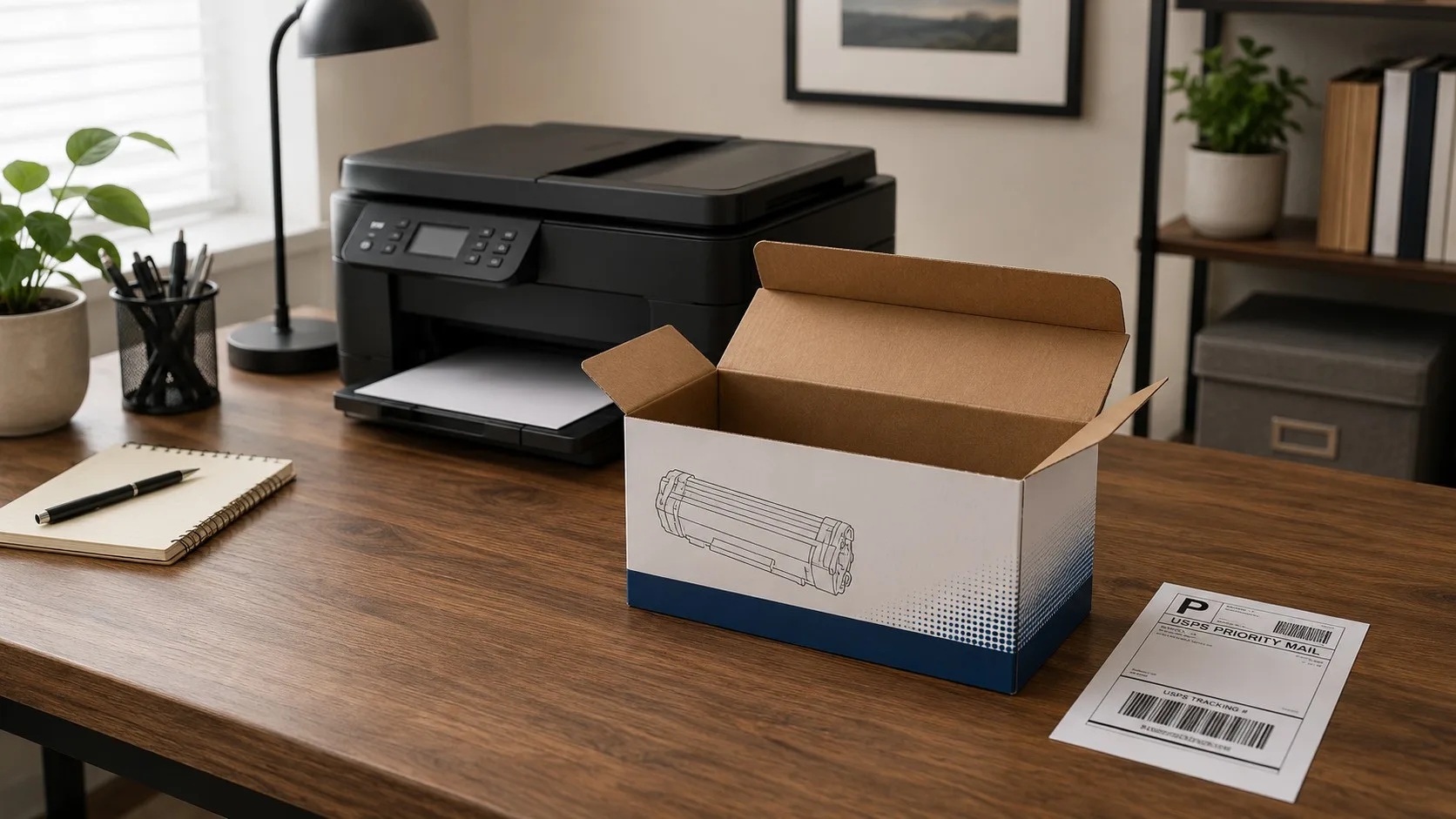
There's a prepaid shipping label sitting in a lot of office supply drawers right now. It came in the box with a new toner cartridge, and it's meant for the old one. Nobody frames this as a sustainability program. It's just what you do when a cartridge runs dry. You put the old one in the box the new one came in, slap on the label, and hand it to whichever carrier already stops by.
That's HP Planet Partners, and it's been running since 1991. Long before we thought about why contact lens recycling programs keep failing, a printer company had already worked out the fix for a completely different object. Not through a sustainability initiative or a design-thinking workshop. Through a shipping label that showed up exactly when it was needed.
A Return System Built in 1991
Here's what Planet Partners actually asks a customer to do. Nothing they weren't already going to do. Take the old cartridge out, since a new one just went in. Put it back in the box, since the box is sitting right there. Apply a label that came free with the order, and give the package to a carrier that already exists in that person's life.
No sorting. No separate trip. No decision about whether today is the day to deal with the old cartridge, because the old cartridge and its replacement never got separated from each other in the first place. The return system rides along with the product.
By 2008, HP had closed the loop on toner plastic. Cartridges that came back through Planet Partners got combined with recycled bottle resin and molded into new cartridges. Today, 100% of Original HP toner cartridges ship with recycled content built in. The old cartridge doesn't just disappear. It becomes the next one.
Use, Reorder, Recover, Repeat
Planet Partners still asks someone to decide when a cartridge is empty and go do something about it. HP Instant Ink removes even that. It's a subscription plan, and the printer itself is the one paying attention.
Once a printer enrolled in Instant Ink gets low, it tells HP directly. A replacement cartridge ships before anyone has to notice ink is running out, let alone place an order. Reordering isn't a task the customer does anymore. It's a task the printer does for them.
Return rides on the same account instead of getting bolted on as an afterthought. An Instant Ink customer requests return supplies from the exact same dashboard that manages their subscription, with a single click under the cartridge status area. There's no separate site to remember, no second login, no different process for the outgoing shipment versus the returning one.
"Use, reorder, recover, repeat. Instant Ink doesn't attach a recovery step to a purchase. It fuses the reorder trigger and the recovery trigger into the same subscription, and the printer sets both off automatically."
That's four steps instead of three, and the customer only does one of them. Use the cartridge until it's empty. The printer reorders on its own. Return the empty cartridge through the same account whenever it's convenient. Repeat the next time a cartridge runs low, which the printer will also notice first. Nobody has to decide when to buy more ink or when to deal with the empty cartridge, because both triggers are already tied to the same device.
It's the same shape of loop LensLoop runs for contact lenses, just with the reorder trigger automated a step further. A subscription that already knows when the next order ships can know just as easily when the old packaging is about to become waste, which is the entire premise behind building recovery into the timing of a reorder instead of a separate errand.
The Numbers After Three Decades
A return system this old has had time to prove whether the design actually holds up, and the totals are the kind of numbers you only get from something people don't have to think about.
Compare that to what most recovery programs manage. The economics behind why landfill wins by default haven't changed, and drop-off recycling programs for small items still capture well under 1% of what's eligible. Planet Partners isn't small. It's one of the oldest product take-back programs in consumer electronics, and it got that big by removing the one thing that kills every other program: a second errand.
What Planet Partners Has in Common With a Bathroom Counter
HP never set out to solve contact lens waste. We never set out to solve printer cartridges. But line the two systems up next to a typical mail-back or drop-off program, and the pattern isn't the object. It's where the return step sits, relative to the moment the old item becomes trash.
| Attribute | Traditional Mail-Back / Drop-Off | Planet Partners / LensLoop |
|---|---|---|
| Where recovery happens | A separate step, arranged later | The exact spot the waste is created |
| Requires remembering | Yes, often for weeks | No, it ships with the product |
| Requires sorting or research | Usually, to find a program that even accepts it | No |
| Return logistics | The person's responsibility | Handled by the company |
| Reorder trigger | Person notices and buys more | Automatic (device usage / subscription cadence) |
| Scale after enough time | Well under 1% of eligible material | 1B+ units (HP) / 93% per-user capture (LensLoop beta) |
"Both systems work for the same reason. Neither one asks a person to remember, sort, or make a special trip. Both simply sit at the place the waste happens."
This is the same shape of fix we wrote about when we looked at why products that fit your routine win, and it's the same reason deposit return systems outperform voluntary ones. Recovery has to meet people where they already are. It can't wait for them to go find it.
How We Landed on the Same Idea
Before LensLoop, we ran Sightly, a platform that let eye care practices sell contact lenses directly to their own patients instead of losing them to online retailers. Over 10,000 patients ordered through it.
Running that business taught us two things that had nothing to do with recycling at first. The garbage can is the real competitor. Any recovery system that's harder to use than throwing something away will lose, no matter how good the intentions behind it are. We also already knew when a patient's next order was shipping, which meant we already knew exactly when their old lenses were about to run out.
Put those two things together and the conclusion is obvious in hindsight. Waste collection has to happen in the bathroom, where the waste is actually created, and it has to line up with the timing of the next order instead of a separate errand someone has to plan. That's the whole idea behind LensLoop: order, use, recover, on a loop nobody has to think about.
HP didn't come from contact lenses, and it built its version of this loop for a printer cartridge decades before we built ours for a blister pack. Different object, same shape of problem. Waste gets left behind at the exact place it's created, so recovery has to happen there too, whether that place is a home office or a bathroom sink.
Our first cohort has been living with this system for 18 months now. What they told us matches the same conclusion HP reached three decades earlier: recovery stops feeling like a chore the moment it stops requiring a decision.
We've proven the capture rate. Now we need the scale.
14 billion lenses get thrown away every year in the US. We've shown that 93% of them don't have to be — if the recovery system is in the right place at the right time. What we need now is more people in the system to prove it holds.
If you wear contact lenses, this is the simplest thing you can do. Join the waitlist. When we're ready to ship, you'll be first.
No commitment. You'll be the first to know when we open.
Frequently Asked Questions
What is HP Planet Partners?
HP Planet Partners is HP's free return and recycling program for ink and toner cartridges, launched in 1991. Customers return used cartridges in the original packaging with a prepaid shipping label, and HP recovers the plastic and metal to make new cartridges and other products.
What is Point-of-Use Recovery?
Point-of-Use Recovery means capturing waste at the exact location and moment it's created, instead of asking someone to store it and travel to a drop-off point later. HP's cartridge return ships with the replacement product. LensLoop's recovery unit sits at the bathroom sink.
Is LensLoop affiliated with HP?
No. LensLoop has no partnership with HP or the Planet Partners program. This article points out a shared design pattern between two unrelated recovery systems, not a collaboration.
What is LensLoop?
LensLoop is a home-based contact lens waste recovery system built around Point-of-Use Recovery. It combines a lens subscription with a bathroom-based recovery unit and a companion app, so recovery happens as part of a routine the wearer already has, with no sorting, storage, or dedicated trip required. A beta program achieved a 93% per-user capture rate. LensLoop is currently expanding its user base and accepts waitlist registrations at getlensloop.com.
Sources & References
- HP (2026). HP Ink & Toner Cartridge Recycling. [Closed-loop recycling process; 100% of Original HP toner cartridges made with recycled content.] hp.com
- HP UK (2026). HP Ink & Toner Cartridge Recycling. [Confirms return materials come included in some cartridge boxes, or via separately ordered prepaid mailers and envelopes.] hp.com/gb-en
- HP History (2021). HP's Planet Partners Toner Recycling Program. [Program launched 1991; closed loop for toner plastics achieved by 2008.] hewlettpackardhistory.com
- HP Support (2026). Recycle HP printers and ink and toner cartridges. [Instant Ink return supplies ordered from the account page; same-account reorder and recycle flow.] support.hp.com
- HP Instant Ink for Business, via Connection Public Sector Solutions (2026). Shop the HP Showcase. [Automatic low-ink reordering; prepaid return shipping as part of the closed-loop program.] govconnection.com
- Quantum Document Management (2023). One billion cartridges recycled via HP Planet Partners program. [1 billion cartridges returned as of December 31, 2022; take-back available in 76 countries and territories.] quantumdocument.com
- LensLoop (2026). Beta program results: 18-month point-of-use recovery pilot. Internal data. [93% capture rate; 2,316 units recovered.]
- LensLoop (2026). Contact Lens Waste: Why Recycling Programs Keep Failing. getlensloop.com
- LensLoop (2026). Why Recycling Is Hard and Landfill Is Easy. getlensloop.com
- Eyes on Eyecare (2025). 2025 Contact Lens Industry Report. [14B annual US discards.] eyesoneyecare.com