
Key Takeaways
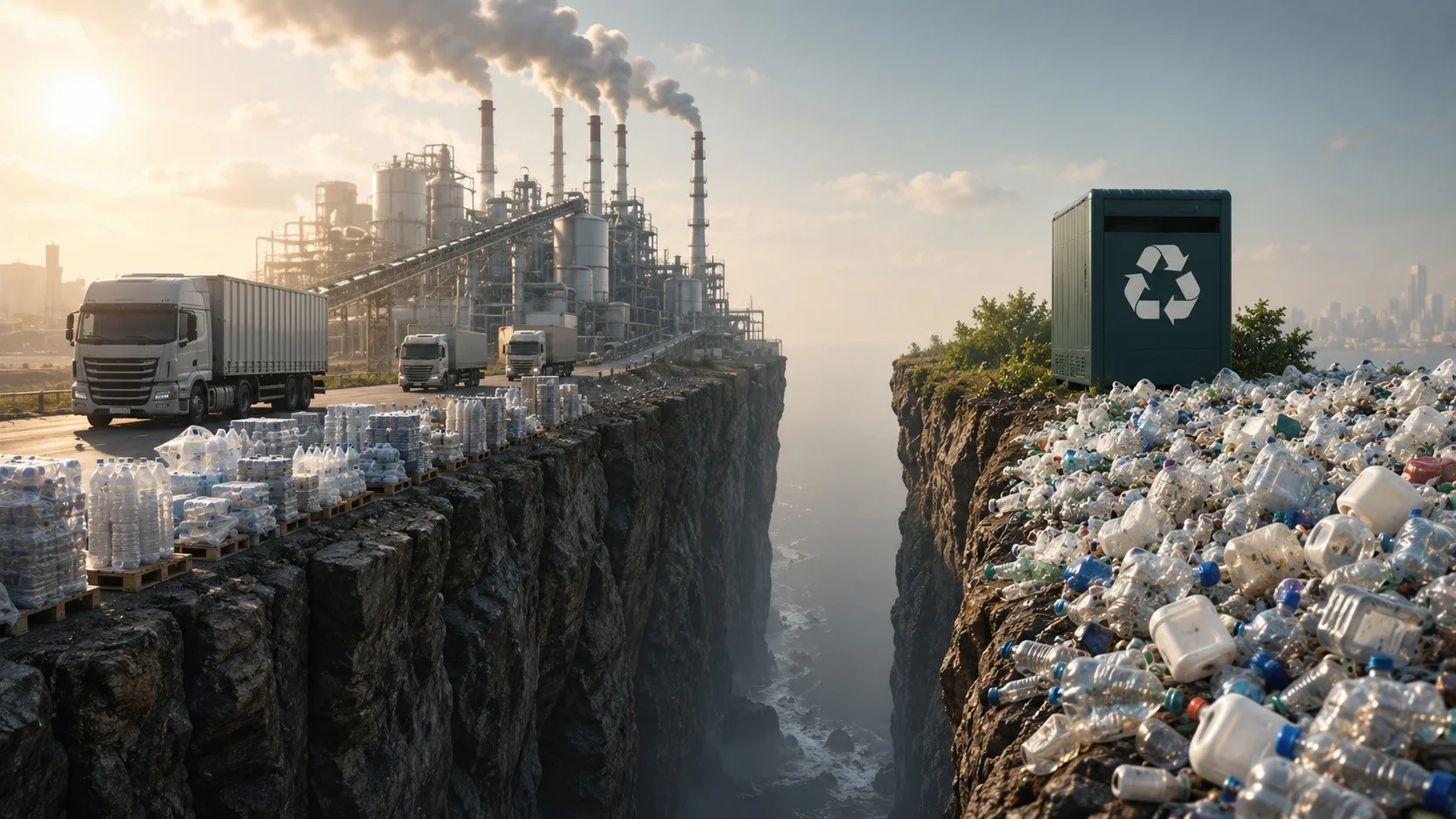
"Only 9% of all plastic ever produced has been recycled. That's not a material problem. It's a system problem. The other 91% reflects a reverse pipeline that was never built to match the scale of production."
"Pollution is what happens when a successful product meets an incomplete system. A plastic bottle collected and recycled has a very different outcome from one discarded into a drain. The material is the same. The system is different."
"Point-of-use recovery places infrastructure at the exact moment and location waste is created. The LensLoop beta achieved 93% capture over 18 months, demonstrating that system design produces fundamentally different participation outcomes than drop-off alternatives."
The Number Nobody Talks About
Every year, millions of tonnes of plastic enter the environment. The usual response is to blame the material. Ban it. Replace it. But there's a number hiding underneath that conversation that most people never look at.
Of every plastic product manufactured since the 1950s, less than one in ten has been recycled. The bottles, the packaging, the bags, etc. The other 91% was incinerated, sent to landfill, or ended up somewhere it was never meant to go.
That's not a material failure. It's a system failure.
"Pollution is what happens when a successful product meets an incomplete system. The question isn't only how we replace plastic. It's how we build systems that prevent materials from becoming pollution in the first place."
Production Got the Investment. Recovery Didn't.
To understand why, look at where the investment actually went.
Since 1950, global plastic production has grown from 2 million tonnes a year to over 400 million tonnes. A two-hundred-fold increase. Alongside that came heavy investment in manufacturing, logistics, marketing, and distribution. The forward pipeline was built to industrial scale.
The reverse pipeline was not.
We built systems to get plastic into the world. We didn't build systems to bring it back.
Think of it like a city that invested heavily in roads but never built parking. Or a factory that doubled production without expanding its warehouse. Eventually the overflow becomes the problem. Not because of what the material is. Because of what happens to it after use.
In 2022, the world generated 267 million tonnes of plastic waste. Of that, only 75 million tonnes were even sorted and collected for recycling. Only half of that was actually processed. The rest was incinerated, landfilled, or lost.
Run the numbers: 9% makes it through. That's not a recycling problem. That's an infrastructure problem.
The Economics Are Working Against Recovery
Why hasn't the reverse pipeline caught up? Partly because the economics actively discourage it.
Virgin plastic, made directly from fossil fuels, is often cheaper to produce than recycled plastic. When oil prices are low, manufacturers have little financial reason to choose recovered material. That price gap isn't accidental. Governments in the top 15 plastic-producing countries subsidise plastic polymer production to the tune of an estimated $45 billion a year. Those subsidies keep virgin plastic artificially cheap and undercut the market for recycled alternatives. There's little economic incentive to close the gap. Plastic Pollution Coalition / CIEL, Plastic Money: Turning Off the Subsidies Tap, 2025
Without a reliable market for recycled material, there's no business case to invest in the infrastructure needed to collect, sort, and process it. So the infrastructure stays underfunded. Patchy. Unequal.
"A plastic bottle collected, segregated, and recycled has a very different outcome from one discarded into a drain, river, or landfill. The material is the same. The system is different."
The 9% Reveals the Design Gap
That 9% isn't evenly distributed. PET bottles and HDPE containers, the ones most visible in consumer recycling bins, fare better than average. But the vast majority of plastic products were never designed with recovery in mind.
Multi-layer packaging. Mixed-material laminates. Small-format items that fall through sorting equipment. Black plastic that infrared sensors can't detect. These aren't accidents. They're the natural output of a system that optimised for production cost and shelf appeal, not for what happens after use.
When a product is designed without a recovery pathway, it doesn't become recyclable just because someone puts it in a bin. The bin isn't the system. The system is everything that has to happen next: collection, transport, sorting, processing, and remanufacture into something useful. For most plastic products, that system either doesn't exist or can't handle what consumers put into it.
Contact lens blister packs are a clear example. Daily disposable wearers generate 730 of them a year. Each is a composite of polypropylene and aluminium foil, both technically recyclable, but rejected by most municipal programs because the pack is too small and the materials are bonded together. None of the existing drop-off programs have cracked it at meaningful scale, because the product was never designed to be recovered, and the system never reached the bathroom where it's discarded.
The Gap Is Projected to Widen
Here's what makes this urgent. Without significant intervention, it gets worse before it gets better.
Global plastic production is projected to double by 2050. Demand driven by packaging growth in Asia and continued petrochemical investment is accelerating it. Plastic waste generation, already outpacing waste management capacity, follows that curve.
That uncollected waste doesn't disappear. It flows into drainage systems, rivers, and oceans. It fragments into microplastics. It accumulates in soil and in food chains. The environmental damage is real and measurable. It's downstream of decisions made much earlier: at the design stage, the policy stage, and the infrastructure investment stage.
What a Complete System Looks Like
The good news: 9% is a baseline. Not a ceiling.
It reflects decades of underinvestment in the recovery half of the system. We know what a more complete system looks like, because parts of it already exist and work.
Countries with deposit return schemes achieve plastic packaging recycling rates roughly double the national averages in countries without them. Extended producer responsibility frameworks shift the incentive so design for recyclability becomes a commercial priority, not a voluntary aspiration.
The system-level levers are clear:
"We invested heavily in manufacturing, distribution, marketing, and consumption. Far less went into recovery, segregation, collection, and circular design. That asymmetry is why plastic keeps accumulating."
Point-of-Use Recovery: Building the Missing Half
We think about this a lot at LensLoop.
Contact lens packaging sits squarely in the design gap. Composite materials. Tiny format. Generated every day. Discarded in the one room in your home where there's no recovery infrastructure at all: the bathroom.
Before LensLoop, we ran a company called Sightly. It was a platform that let eye care practices offer online contact lens ordering directly to their patients. At its peak, Sightly had over 10,000 patients ordering through it. When we learned about the scale of contact lens waste, two things became immediately clear.
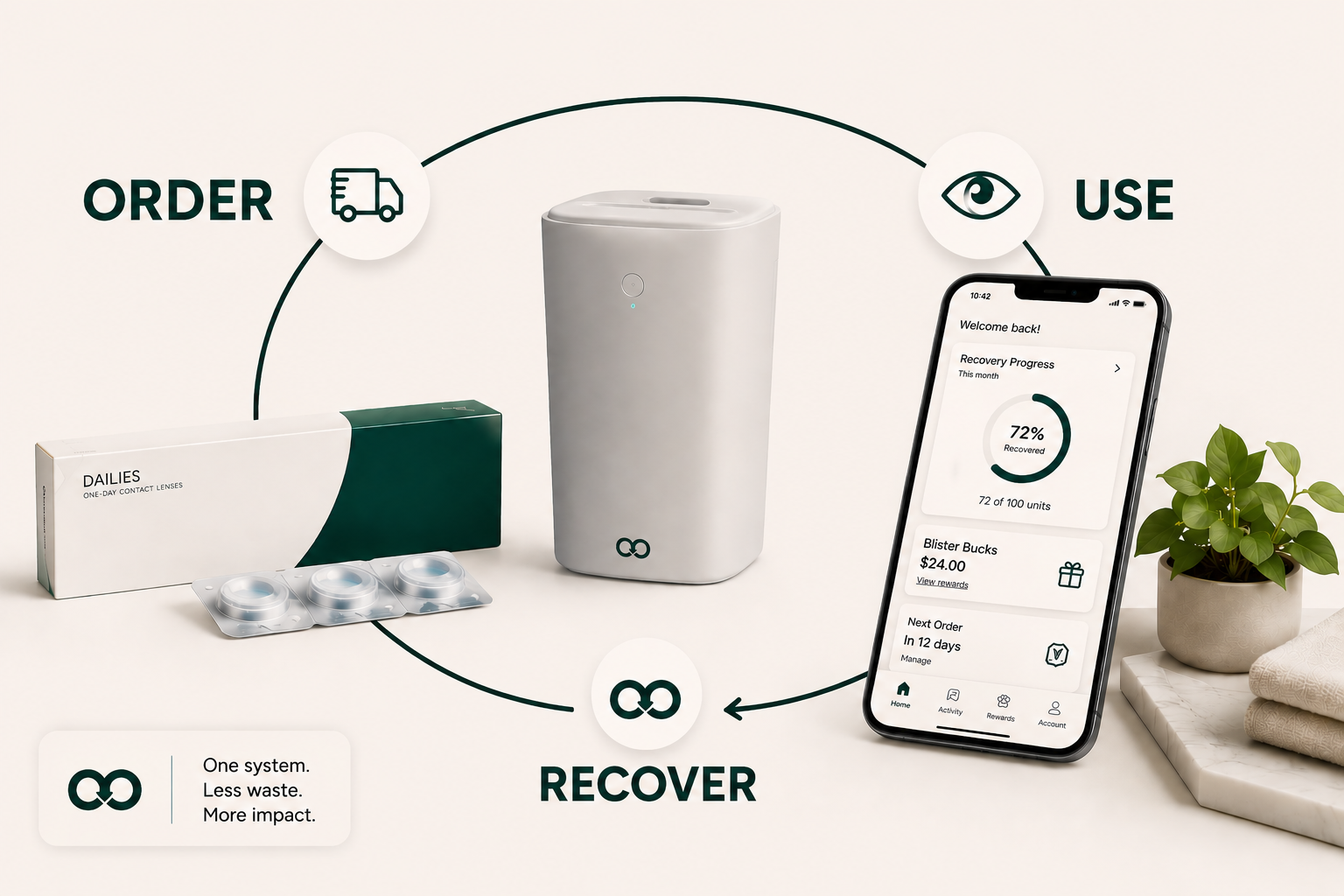
First: the garbage can is the real competitor. Any recovery system that's harder to use than throwing something away is going to lose. It has to be at least as easy. Ideally easier. Second: through Sightly, we already knew when a patient's next lens order was going to ship. That timing is everything. If you know when someone is going to run out of lenses, you know exactly when to collect their waste.
The conclusion was straightforward. Waste collection has to happen in the bathroom, where the waste is created. The collection has to be timed with the delivery of new supply. That's the foundation of LensLoop.

We didn't just theorize about this. We ran it.
Over 18 months, we put the LensLoop system into real bathrooms and measured what actually happened. Not in a lab. Not in a survey. In people's daily routines.
93% is the number that matters. It's not a projected rate or a survey result. It's what happened when we placed recovery at the point of use and removed every step between waste creation and waste capture.
The 7% we didn't capture is real too. Travel days, illness, away-from-home routines. That's the honest ceiling of any bathroom-based system. It's still higher than anything the existing drop-off programs achieve against 14 billion annual lens discards in the US.
"LensLoop merges the lens subscription and the recovery system into one loop. The user doesn't adopt a recycling habit. They continue their existing habit, and the system captures the waste as a byproduct."
The Question Worth Asking
The 9% figure tends to generate two reactions.
Despair: if we've produced this much plastic and recovered so little, what's the point? Or a more useful question: what would have to be true for that number to be 50%? 70%? 90%?
The answer isn't a new material. It's a complete system. One that extends all the way to where products are actually used, and where waste is actually created.
Plastic pollution is made up of smaller gaps. Product categories, waste streams, and moments in daily life where the recovery system doesn't reach. Contact lens packaging is one of them. It's solvable. We have the data to prove it.
The 9% isn't a verdict on what's possible. It's a measure of how much of the system we've yet to build.
We've proven the capture rate. Now we need the scale.
14 billion lenses get thrown away every year in the US. We've shown that 93% of them don't have to be — if the recovery system is in the right place at the right time. What we need now is more people in the system to prove it holds.
If you wear contact lenses, this is the simplest thing you can do. Join the waitlist. When we're ready to ship, you'll be first.
No commitment. You'll be the first to know when we open.
Frequently Asked Questions
What percentage of plastic has actually been recycled?
Only 9% of all plastic ever produced has been recycled. In the United States, the annual rate is even lower, around 5 to 6% of plastic waste recycled each year. The global rate has remained stagnant at this level despite decades of recycling programs and growing public awareness. (Source: OECD / EcoWatch, 2025)
Why is plastic recycling so low?
Investment went almost entirely into production and distribution, not recovery. Virgin plastic is often cheaper than recycled material because fossil fuel feedstocks are subsidised. Collection infrastructure is underfunded and unequal. Most products were never designed to be recovered in the first place. The result is a forward pipeline built to industrial scale, with a reverse pipeline that has never matched it.
What is the plastic recycling infrastructure gap?
The infrastructure gap is the mismatch between the industrial scale built for producing and distributing plastic and the far smaller system that exists to collect, sort, and recover it. Closing that gap is a prerequisite for meaningful improvement in recycling rates, regardless of how motivated consumers are.
Will plastic waste get worse?
Under current trajectories, yes. Global production is projected to double by 2050. Uncollected plastic waste could nearly triple between 2025 and 2040 even as infrastructure investment grows. The gap between what we produce and what we recover is widening, not closing. (Source: Pew Charitable Trusts, 2025)
What does point-of-use recovery mean?
Point-of-use recovery means capturing waste where and when it is created, rather than requiring users to store it and travel to a drop-off location later. For contact lens packaging, this means a bathroom-based recovery unit integrated into the daily lens removal routine. The goal is to make recovery the default, so participation doesn't depend on sustained motivation or deliberate behaviour change.
What is LensLoop?
LensLoop is a home-based contact lens waste recovery system built around point-of-use recovery. It combines a lens subscription with a bathroom-based recovery unit and a companion app, so recovery happens as part of the routine the wearer already has. A beta program achieved a 93% per-user capture rate over 18 months. LensLoop is expanding its user base and accepts waitlist registrations at getlensloop.com.
Sources & References
- OECD (2025). Global Plastics Outlook. [9% global recycling rate; 267Mt waste generated in 2022.]
- EcoWatch (April 2025). Global Plastic Recycling Rate 'Stagnant' at 9%: Study. ecowatch.com
- Society of Chemical Industry (2025). Plastic recycling rates are stubbornly low: Here's what's going wrong. [41% incineration rate for sorted plastic.] soci.org
- Pew Charitable Trusts (2025). Breaking the Plastic Wave 2025. [1.5B people without waste collection; 3x uncollected waste projection to 2040.] pew.org
- Statista (2025). Plastic waste worldwide: statistics & facts. [400M+ tonnes annual production.] statista.com
- Communications Sustainability / Nature (April 2026). Geospatial analysis reveals socioeconomic inequities in access to recycling infrastructure in the United States. [Recycling disparities linked to infrastructure access, not waste generation.] nature.com
- Plastic Reimagined / EPA (2026). From Collection to Conversion: Why U.S. Infrastructure Determines Recycling Success. [88% of US states do not track single-use plastics in commerce.] plasticreimagined.org
- Plastic Pollution Coalition (January 2025). Hidden Costs: Plastic Subsidies Drain Public Resources and Threaten Human Health. / CIEL (2025). Propping Up a Failing Industry. [$45B annual subsidies to plastic polymer industry in top 15 producing countries.] plasticpollutioncoalition.org · ciel.org
- LensLoop (2026). Beta program results: 18-month point-of-use recovery pilot. Internal data. [93% capture rate; 2,316 units recovered.]