
Key Takeaways
"Myopia rates in North America have increased 50% over two decades to roughly 42% of the population. Nearly 30% of Canadian school children aged 11 to 13 are already myopic, and rates continue to rise."
"If a child diagnosed with myopia today becomes a full-time daily lens wearer for 50 years, they will generate over 36,000 blister packs — roughly 36.4 kg of plastic at 1 kg per year — almost none of which enters a recovery system."
"100,000 myopic Canadian children in a 50-year daily wear scenario generate 3.6 billion blister packs: nearly 5,000 tonnes of plastic, or the weight equivalent of 418 fully loaded school buses headed for landfill."
"Children forming lens habits for the first time are the most recoverable population of contact lens wearers. There is no existing habit to change. Recovery built in at the start stays built in for life."
"If 10,000 myopic Canadian children start on LensLoop at the point of transition to daily lenses, and sustain a 93% capture rate across 50 years of wear, that is over 334 million blister packs diverted from landfill. From one country. From one generation."
A Vision Condition Becoming a Global Epidemic
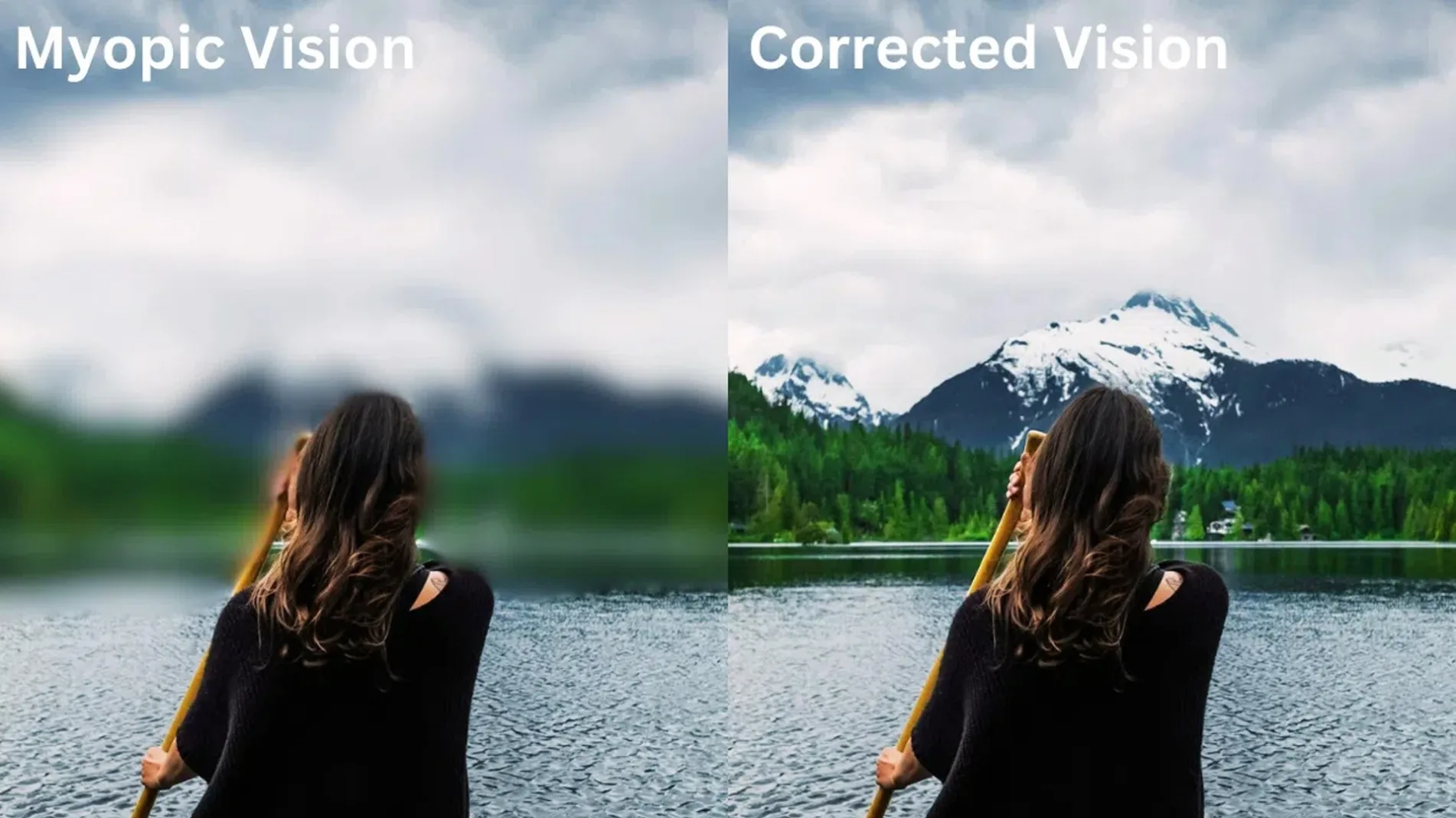
Myopia, commonly known as nearsightedness, is a vision condition where close-up objects are clear but distant objects appear blurry. It happens because the eye grows slightly too long, causing light to focus in front of the retina rather than directly on it. It's one of the most common refractive errors in the world, and it almost always develops in childhood.
For most families, the story starts simply. A child squints at the classroom whiteboard; the teacher notices; an eye exam confirms myopia, and corrective contact lenses are prescribed. What most families don't realize is that this diagnosis is the beginning of something much longer than a prescription change.
Myopia rates in North America have increased 50% over the last two decades, rising from 28% of the population to roughly 42%. Among Canadian school children aged 11 to 13, close to 30% are already myopic. The World Health Organization projects that if current trends continue, half of the world's population will be nearsighted by 2050. Researchers at OHSU's Casey Eye Institute describe the trend as indisputable, driven by a combination of genetics, reduced time outdoors, and increased near work on screens and digital devices.
The public conversation about this epidemic focuses almost entirely on vision. That makes sense. But there is another dimension to this story that nobody is talking about, and it has nothing to do with eyesight.
From MiSight to a Lifetime of Dailies
When a child is diagnosed with progressing myopia, one of the first things their optometrist considers is whether to prescribe a myopia management lens. The goal is not just vision correction but to slow the rate at which the prescription worsens, because children whose myopia progresses unchecked are at significantly higher risk of serious complications later in life, including retinal detachment, glaucoma, and macular degeneration.
MiSight 1 day is currently the only FDA-approved daily disposable contact lens specifically designed to slow myopia progression in children. It is a full-time, daily-wear lens, meaning a child prescribed MiSight is typically wearing it 720 times a year, 360 per eye, generating 720 blister packs in the process.
Over time, with consistent wear, the progression slows. The doctor monitors axial length and refraction at regular intervals. Once progression has stabilized enough, the child graduates to a standard daily disposable lens. That transition typically happens somewhere in the early to mid teens. From that point forward, assuming they continue with daily lenses, the waste output stays the same: 720 blister packs a year, year after year.
"If a child starts on MiSight at age 10 and transitions to a standard daily lens at 13, and continues as a full-time daily lens wearer until age 65, that is 52 years of daily wear. This is a plausible lifetime scenario for a child diagnosed with myopia today."
That scenario produces 36,000 blister packs from one person. Before counting anything used during the MiSight years. The number is striking on its own. What makes it more significant is how many children are now entering this pathway, and how early the habit forms.
What 36,000 Blister Packs Actually Means
It is hard to picture 36,000 of anything. So let's use a number we've already measured.
In our article on contact lens waste, we showed that 10 daily lens wearers generate 7,244 blister packs in a single year. We know this because we collected and counted every one. Together, those 7,244 packs fill a standard bathtub.
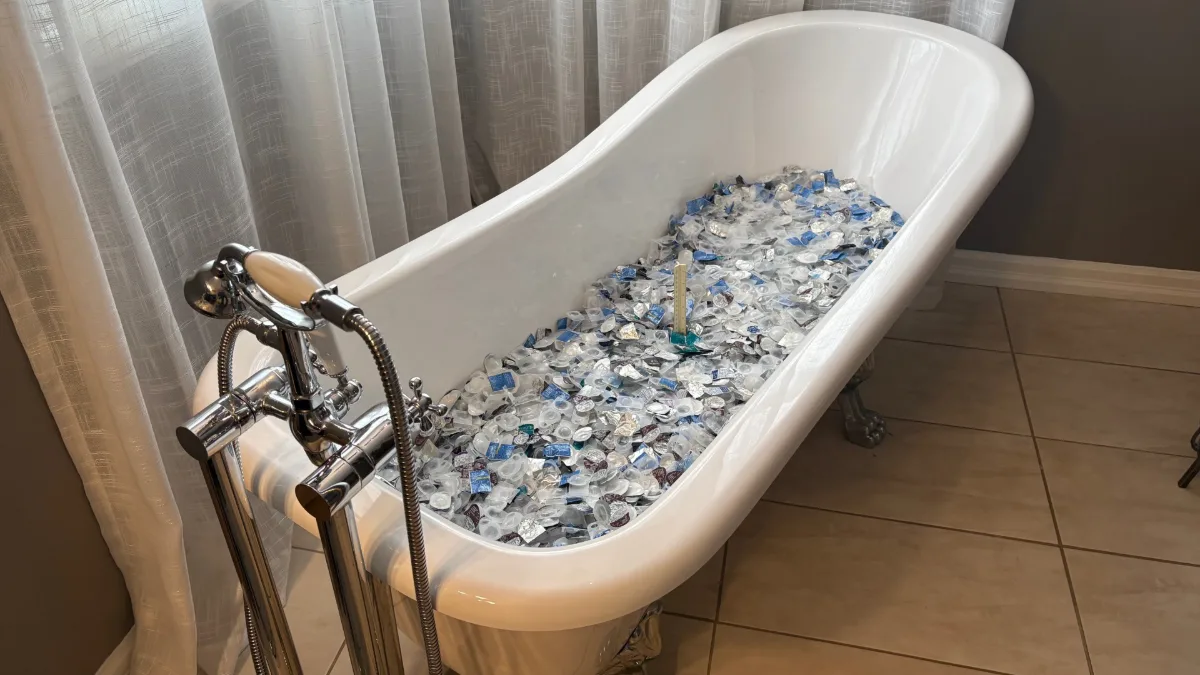
That's a bathtub full of 7,244 used contact lens blister packs. We collected and counted every one. It's what 10 daily lens wearers throw away in a single year. Each pack disappears in two seconds. Together, they fill a bathtub.
If a single myopic child wears daily lenses full time for 50 years, they generate the equivalent of five of those bathtubs - by themselves. That is 36,000 packs and 36.4 kg of plastic, at 1 kg per year, almost none of which enters a recovery system.
Multiply that across the tens of thousands of children currently entering the daily lens pathway through myopia management programs, and the scale becomes very difficult to comprehend.
100,000 Children. 3.6 Billion Blister Packs.
Let's make this concrete.
There are roughly 390,000 myopic children in Canada in the 11 to 13 age group alone. Take just 100,000 of them, about one in four, and apply the same 50-year daily wear scenario.
100,000 children. 720 blister packs per year each. 50 years of daily wear. That is 3.6 billion blister packs. Nearly 5,000 tonnes of plastic. The weight equivalent of 418 fully loaded school buses, headed straight for landfill.
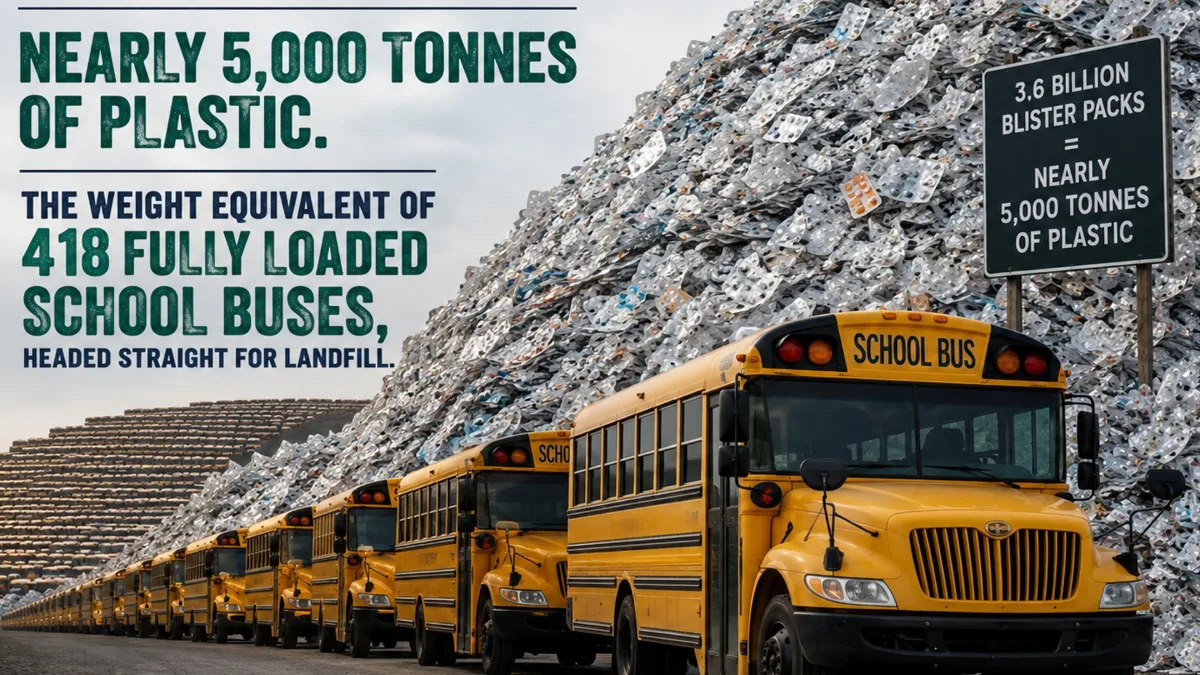
None of that plastic exists yet. These are children who are wearing MiSight right now, or being fitted for glasses this year. Their daily disposable habit has not started. The question of whether that waste gets recovered is still open.
"100,000 myopic Canadian children in a 50-year daily lens wear scenario would generate the weight equivalent of 418 fully loaded school buses in blister pack plastic. The habit that determines whether any of it gets recovered is being formed right now."
The Habit Forms Before the Problem Is Visible
Here is what makes this situation different from the adult contact lens waste problem.
When an adult starts wearing daily contact lenses, the disposal routine is already set by context. Every other adult around them tosses the pack. The bin is right there. The behavior embeds itself on day one without anyone making a conscious choice. By the time the topic of waste recovery comes up, the habit has been running for years, and changing it requires deliberate, repeated effort.
A child starting with contact lenses does not have that history. They are learning the lens routine from scratch, in the context of a structured clinical relationship with their optometrist. That is a genuinely rare window. The habit has not been formed. The default has not been set.
If recovery is built into that routine from the start, it does not become a habit the child has to remember to maintain. It becomes the only routine they have ever known. That is a fundamentally different situation from retrofitting recovery onto an adult who has been discarding packs for a decade.
"The best time to build contact lens waste recovery into someone's routine is before any other routine exists. For a child starting on MiSight, that moment is now. It will not come again."
What LensLoop Does for a Lens Wearer Starting Young
LensLoop is a home-based recovery system built around a simple principle: waste has to be captured at the moment it is created, in the place it is created. Not stored for weeks and dropped off somewhere. Not mailed in batches. Captured in the bathroom, when the lens comes out, the same moment it has always been discarded.
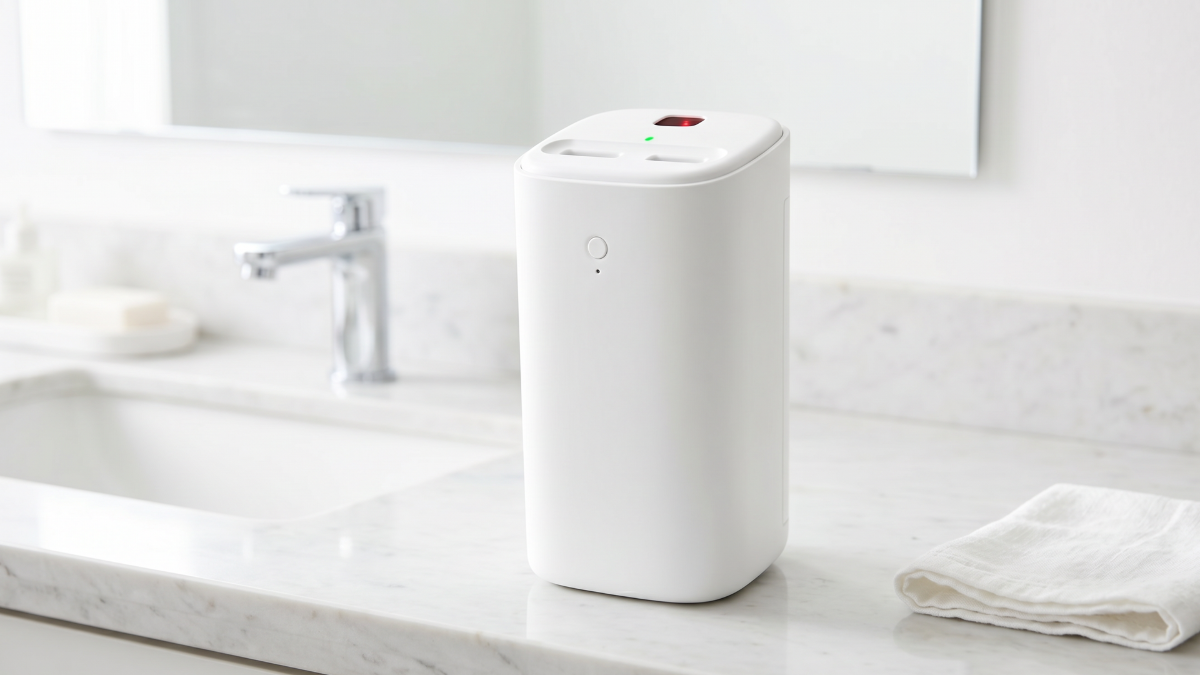
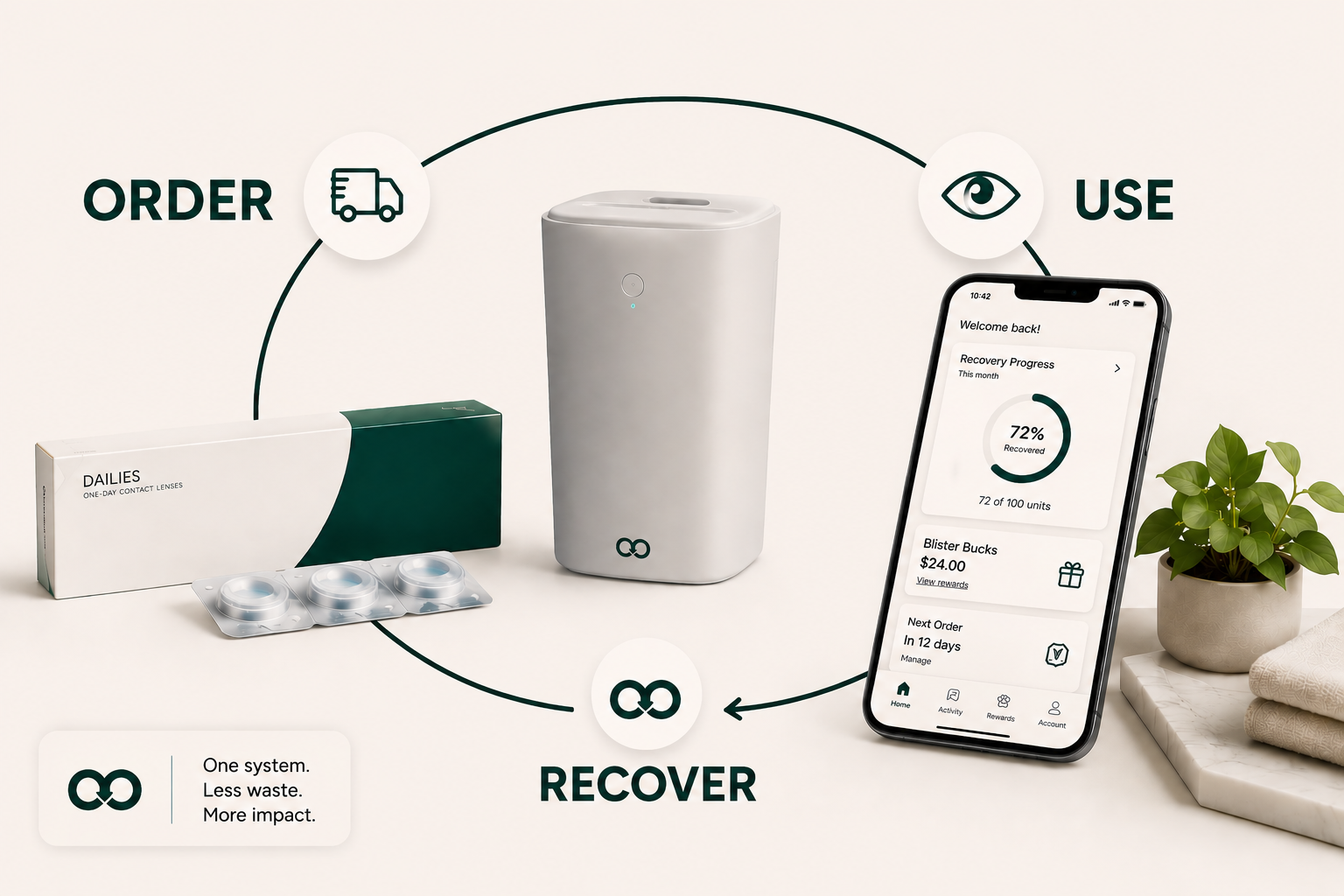
The system works in three steps.
For an adult who has been throwing away blister packs for years, this is a habit change. For a child who is learning the lens routine for the first time, it is just the routine.
That distinction matters more than it might seem. The easier an action is, the more likely it sticks. LensLoop works for adults. For a child who starts with it from day one, there is no competing behavior to displace. Recovery is built in before anything else has a chance to be.
"LensLoop merges the lens subscription and the recovery system into one loop. The user does not adopt a recycling habit. They continue their existing habit. The system captures the waste as a byproduct."
If We Get to Kids Early, What Changes?
Our beta program achieved a 93% per-user capture rate over 18 months across 2,316+ recovered units. That number holds when the system is the default. Not when it is fighting a habit, but when it is the habit.
At 93% capture across a 50-year wear lifetime, a single child who starts with LensLoop diverts roughly 33,480 blister packs from landfill. About 46 kg of plastic. From one person.
Scale that across even a fraction of the children currently entering the daily lens pathway through myopia management programs across Canada and North America, and the impact is not a rounding error. It is a category shift.
"If 10,000 myopic Canadian children start on LensLoop when they transition to daily lenses, and sustain a 93% capture rate across 50 years of wear, that is over 334 million blister packs diverted from landfill. From one country. From one generation."
The Window Is Now
Myopia diagnoses are being made in clinics right now. Children are transitioning off MiSight and onto standard daily lenses right now. The routines that will govern decades of lens wear are being established right now.
Most of those children will never think about where the blister pack goes. It will disappear into the trash the same way it does for every adult who started wearing lenses before any of this existed. That is just how defaults work, and there is nothing surprising about it.
For the children who start with recovery already built into the routine, the waste does not disappear. It gets captured. Every day, for decades, without ever requiring a separate decision.
That window is open right now. It will not stay open forever.
We've proven the capture rate. Now we need the scale.
14 billion lenses get thrown away every year in the US. We've shown that 93% of them don't have to be — if the recovery system is in the right place at the right time. What we need now is more people in the system to prove it holds.
If you wear contact lenses, this is the simplest thing you can do. Join the waitlist. When we're ready to ship, you'll be first.
No commitment. You'll be the first to know when we open.
Frequently Asked Questions
What is myopia?
Myopia, commonly known as nearsightedness or shortsightedness, is a vision condition where close-up objects are clear but distant objects appear blurry. It occurs when the eye grows slightly too long, causing light to focus in front of the retina rather than directly on it. It is one of the most common refractive errors worldwide and almost always develops during childhood.
What is MiSight and how long do children use it?
MiSight 1 day is a daily disposable contact lens designed specifically to slow the progression of myopia in children. It is the only FDA-approved daily disposable lens for this purpose. Children wear it full time, generating 720 blister packs per year. Once a child's optometrist determines that progression has stabilized, typically in the early to mid teens, the child transitions to a standard daily disposable lens.
How many blister packs would a child generate wearing daily contact lenses for 50 years?
A full-time daily lens wearer generates 720 blister packs per year, which works out to 1 kg of packaging plastic annually. Over a 50-year wear scenario, that is 36,000 blister packs and roughly 36.4 kg of plastic from one person. This is an illustrative projection, not a clinical prediction, but it reflects what is possible for a child who enters the daily lens pathway through myopia management and continues as a full-time wearer into adulthood.
What does the 100,000 children figure represent?
There are roughly 390,000 myopic children in Canada in the 11 to 13 age group alone. Taking 100,000 of them, about one in four, and applying a 50-year full-time daily wear scenario produces 3.6 billion blister packs, nearly 5,000 tonnes of plastic, or the weight equivalent of 418 fully loaded school buses. This is an illustrative projection to show the scale of what is at stake if recovery is not built into the habit from the start.
How prevalent is myopia in Canadian children?
Studies show myopia affects close to 30% of Canadian school children aged 11 to 13. Across North America, prevalence has increased 50% over the last two decades to roughly 42% of the population. The World Health Organization projects that half of the world's population will be myopic by 2050 if current trends continue.
Why is starting a child on LensLoop different from starting an adult?
Adults who have been discarding blister packs for years have an established disposal habit to change. A child who starts with LensLoop from day one has no prior routine to displace. Recovery becomes the only lens routine they have ever known, and that makes it far more likely to persist. The behavioral research is consistent on this point: defaults are far more powerful than motivation, and the best time to set the right default is before any other default exists.
What recovery rate does LensLoop achieve?
LensLoop's closed beta program achieved a 93% per-user capture rate over 18 months, recovering 2,316+ units. Applied to a 50-year daily wear scenario, a child who starts on LensLoop would divert roughly 33,480 blister packs from landfill across their lifetime. At 10,000 children, that is over 334 million packs diverted from one generation in one country.
Sources & References
- Holden BA, et al. (2016). Global Prevalence of Myopia and High Myopia and Temporal Trends from 2000 through 2050. Ophthalmology. 123(5): 1036–1042. [42% North American prevalence; 50% two-decade increase; 50% global projection by 2050.]
- Yang, M., Luensmann, D., Fonn, D., et al. (2018). Myopia prevalence in Canadian school children: a pilot study. Eye. 32, 1042–1047. doi.org/10.1038/s41433-018-0015-5. [~30% of Canadian school children aged 11–13 affected.]
- CooperVision Canada (2024). Myopia Epidemic. coopervision.ca. [North American prevalence data; MiSight clinical overview; Canadian optometrist survey data.]
- OHSU Casey Eye Institute (2022). Myopia on the rise, especially among children. ohsu.edu. [Near work and screen time as drivers; genetics; outdoor time as protective factor; Dr. Douglas Fredrick commentary.]
- CooperVision (2024). MiSight 1 day Canadian Indications for Use. coopervision.ca. [MiSight indicated for myopia control in children aged 6–18; daily disposable; slows progression during lens wear.]
- Efron, N., et al. (2021). Waste composition data. Contact Lens & Anterior Eye. [~1 kg waste per daily wearer per year at 720 packs; 64% polypropylene by mass; per-unit weight of 1.40g basis for lifetime projections.]
- Eyes on Eyecare (2025). 2025 Contact Lens Industry Report. eyesoneyecare.com. [730 units per daily wearer annually; 14B US annual discards; 53% daily disposable fit rate.]
- Statistics Canada (2024). Population estimates by age and sex. Table 17-10-0005-01. [Canadian school-age population basis for 390,000 myopic children aged 11–13 estimate.]
- LensLoop (2026). Beta program results: 18-month point-of-use recovery pilot. Internal data. [93% capture rate; 2,316+ units recovered.]
- LensLoop (2026). Lifetime waste projection methodology. Based on 720 packs/year x 50 years of full-time daily disposable wear, using per-unit weight of 1.40g derived from Contact Lens & Anterior Eye (Efron et al., 2021). School bus weight benchmark: 11,793 kg gross vehicle weight. All projections are illustrative. Not clinical predictions or guarantees.